
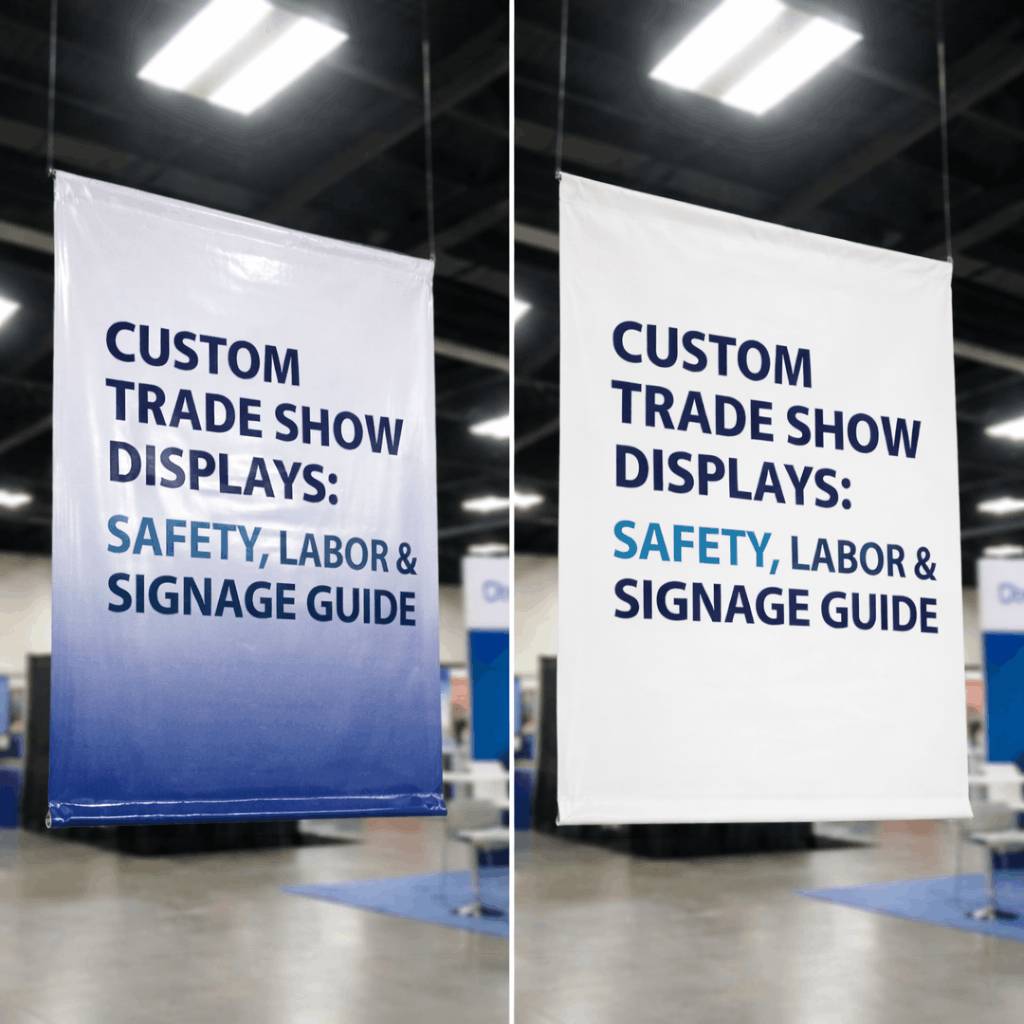
Custom trade show displays must meet NFPA 701 fire safety standards at all major U.S. venues, use matte vinyl to prevent glare under convention lighting, and comply with union labor rules that vary by city. Exhibitors with smaller booths (typically under 200-500 sq ft) can often handle their own booth setup, but hanging signs, electrical work, and using power tools require union labor in most jurisdictions.
This guide covers everything exhibitors need to know for 2026: fire safety certifications, union labor jurisdictions, signage materials, booth setup rules, and logistics timelines for venues across North America.
Whether you’re exhibiting at Tier-1 convention centers or regional facilities, understanding these regulations before your upcoming trade shows saves time, money, and stress. The results of non-compliance range from mandatory material removal and fines to booth shutdown.
The sections below provide the detailed guidance your team needs to execute a compliant, professional exhibit that connects with your target audience, helps you attract visitors, and drives marketing success on the trade show floor.
Fire Safety & Flame Retardant Banners (NFPA 701)
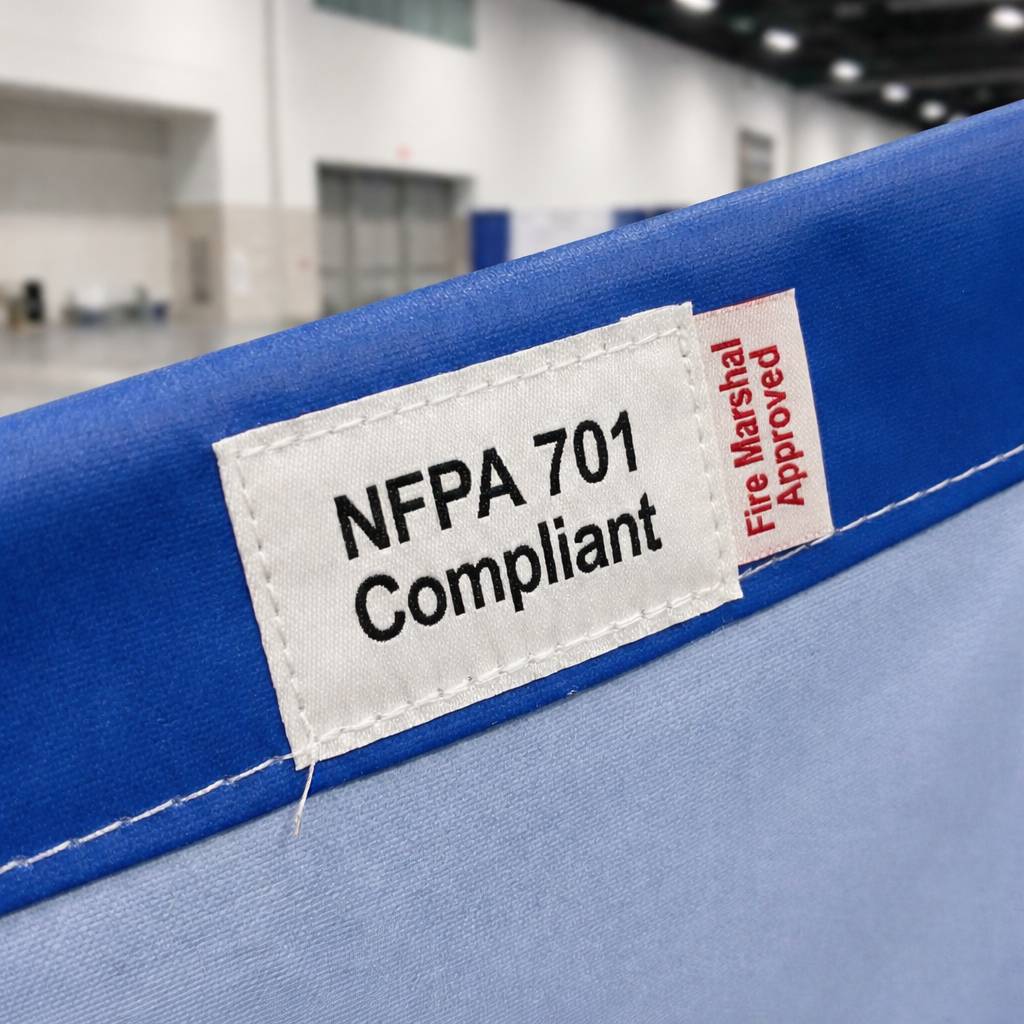
Fire safety sits at the top of every venue’s enforcement priorities across North America. The NFPA 701 standard—developed by the National Fire Protection Association—governs flame resistance for textiles and films used in public assembly spaces. Tier-1 convention centers uniformly require that all bunting, table covers, drapes, signs, banners, and like materials must be flame resistant and subject to inspection and flame testing by the Fire Marshal.
Venues across the country explicitly prohibit materials that cannot be treated for flame retardancy. Oil cloth, tarpaper, nylon, plastic cloths, and certain other plastic materials cannot be made flame retardant and their use is prohibited at major U.S. event facilities.
The certification requirement is non-negotiable. You must have documentation proving your materials meet NFPA 701 standards—the national fire-safety test for textiles and films. This test measures how materials react to fire: do they self-extinguish once the flame is removed? How far do flames spread across the surface?
What you need on-site:
- An NFPA 701 compliance tag sewn directly into the fabric (preferred)
- A paper certificate of flame retardancy from the manufacturer
- Documentation showing the material is “self-extinguishing”
The Fire Marshal’s decision on compliance is final. If your materials fail a field “match flame test,” they must be removed right away—no appeals, no exceptions. This standard applies uniformly whether you’re exhibiting in Las Vegas, Chicago, Orlando, or any other major convention destination.
Standard Vinyl vs. Fire Retardant Vinyl: The Critical Difference
Standard vinyl and fire-retardant (FR) vinyl look nearly identical, but their behavior during a fire couldn’t be more different. Standard vinyl can ignite readily, contribute to flame spread, and potentially melt and drip—making it a serious fire hazard in crowded public spaces.
Fire-retardant vinyl is engineered with chemical additives built in during manufacturing that interrupt the combustion process. When exposed to flame, FR vinyl chars and self-extinguishes rather than igniting into a spreading fire.
| Property | Standard Vinyl | Fire Retardant Vinyl |
|---|---|---|
| Ignition behavior | Readily ignites, spreads flame | Self-extinguishes, chars |
| Melting | Can drip molten material | Minimal dripping |
| NFPA 701 certification | Does not meet standard | Certified compliant |
| Trade show use | Prohibited | Required |
| Cost | Lower | Slightly higher |
The cost difference for FR vinyl is minimal compared to the compliance risks. When ordering banners for any trade show exhibits nationwide, explicitly request NFPA 701-certified materials and ask your vendor to include the certificate with delivery. This small addition to your budget ensures your custom trade show displays and custom exhibits meet all safety requirements at any venue.
Additional Fire Safety Requirements
Beyond signage materials, major U.S. event facilities enforce strict fire safety rules:
Prohibited without written consent:
- Open-flame devices, candles (unless completely covered with water base)
- Welding, cutting, or brazing equipment
- Pyrotechnics or fireworks
- Compressed flammable gases
- Portable heating equipment
Structural requirements:
- Any booth with a ceiling or enclosed space needs a smoke detector and fire extinguisher
- Double-decker booths require structural drawings stamped by a licensed engineer
- Floor plans must be submitted to the Event Manager at least 90 days prior for Fire Marshal approval
Clearance requirements:
- No exhibit materials within 20 feet of main entrances or loading dock exits
- Aisles must be minimum 10 feet wide
- Fire exits and fire safety equipment cannot be blocked
ADA Compliance for Custom Trade Show Displays
National exhibitors must comply with the Americans with Disabilities Act (ADA), which is often more strictly enforced at large national shows than at smaller regional events. Key requirements include:
Booth flooring: Any raised flooring or platform must include a ramp with a slope no steeper than 1:12. Carpet edges must be secured to prevent tripping hazards.
Counter heights: If your custom display includes transaction counters or areas to display products, at least one section must be accessible at 36 inches or lower for wheelchair users.
Aisle clearance: Maintain minimum 36-inch pathways within your booth space for wheelchair access.
Signage placement: Ensure critical information is visible from seated eye level (approximately 43-51 inches from floor).
Failure to meet ADA requirements can result in complaints, fines, and negative publicity. Most General Service Contractors can provide ADA compliance checklists specific to your booth configuration.
Maximizing Versatility with Modular Booth Design
For exhibitors touring multiple cities, modular trade show exhibits offer significant advantages over custom-built structures. A well-designed modular system allows a single custom display to scale from a 10×10 at a regional show to a 20×20 at a national convention—without requiring entirely new graphics or structural components.
Many modern custom builds use modular components, allowing reconfiguration of materials for different booth sizes as your event calendar evolves. Custom modular trade show exhibits can be tailored to reflect your brand’s unique identity while offering flexibility and adaptability across different shows.
Cost benefits of modular systems:
- Reduced drayage costs: Lighter, standardized crates mean lower material handling fees and reduced shipping costs at each venue
- Faster setup times: Many portable exhibits can be assembled without tools, and a single person can often complete booth setup in under an hour
- Flexible configurations: Reconfigure the same elements for inline, corner, or island booth assignments
- Lower shipping weight: Portable trade show displays are lightweight, which simplifies shipping and enables easy transport between events
Popular modular systems include:
- Tension fabric displays with interchangeable SEG graphics
- Aluminum extrusion frames that connect in multiple configurations
- Portable lightbox walls that pack flat for shipping
- Modular counters and pedestals with swappable branded panels
Using modular, reusable systems and eco-friendly materials like recycled aluminum or bamboo reflects brand values and appeals to conscious audiences. When planning your national tour, consider investing in a modular system that meets NFPA 701 requirements across all components. This ensures compliance at every venue while maximizing your return on investment—a truly cost-effective solution for exhibitors attending multiple events.
Creating Maximum Impact with Your Booth Displays
A good trade show display should be visually engaging, clearly communicate your brand message, and effectively showcase your products or services. According to recent 2026 industry research, successful booths can capture attention within the first three seconds—making first impressions critical.
Design elements that attract attention:
- Utilize bold custom graphics and strategic lighting with LED lights to make your booth stand out
- Incorporate interactive elements like touchscreen kiosks, VR/AR demos, or promotional games to engage attendees
- Use vertical space with hanging banners, lightbox towers, or tall fabric backdrops to be visible from 20-50 feet away on the trade show floor
- Incorporate LED edge lighting, spotlights, and backlit signage to create depth and draw focus to key products
Booth layout considerations: A well-thought-out booth layout allows visitors to explore and learn about your product or service without feeling crowded. Custom layouts can be designed to support specific goals, such as dedicated spaces for client meetings or built-in storage for samples.
Staff engagement: Engaging booth staff who are knowledgeable and approachable can significantly enhance visitor interaction. Your team should be trained to engage attendees, qualify leads, and represent your professional presence effectively.
A professionally designed, custom booth projects credibility and trustworthiness to potential clients. High-quality, specialized designs attract more attendees and increase booth traffic, creating opportunities to connect with prospects.
Booth Stand and Display Options by Size
Choosing the right trade show display depends on your space, budget, and goals. Here’s what works for various sizes:
8ft Booth or Tabletop Display An 8ft booth or tabletop display is ideal for startups with limited budgets. These compact booth displays work well for businesses just entering the trade show circuit. Simple tabletop displays can start at a few hundred dollars, making them accessible for new exhibitors.
10×10 Booth (Inline) Space is limited:—use vertical elements effectively. Portable displays like retractable banner stands (33″ x 80″) provide height without consuming floor space. Tabletop displays and table covers add branding without clutter. Keep the front of your booth clear for visitor interaction. Most 10ft booths fall between $579 and $1,129.
Height restriction: Back wall maximum 8 feet. Front 5 feet of booth (near aisle) cannot exceed 4 feet to preserve neighbor sightlines.
10×20 Booth (Double Inline): More room for multiple graphics or a wider backdrop system. Consider two banner stands flanking a central product display, or a 10-20 foot fabric backwall. Corner booths (open on two sides) need signage facing both traffic directions. This extra space lets your team explore creative solutions and showcase creativity while meeting exhibit needs.
20×20 Island Booth: Maximum flexibility with exposure on all sides. These booths can fit larger structures (up to 16-20 feet depending on show rules), hanging signs (if permitted and union-installed), and multiple entry points. Ensure your brand presence is visible from all four directions. Prices for custom trade show booths at this size can range from $5,000 to $50,000 or more depending on customization options.
Key consideration: Island booths almost always require union labor for booth setup due to size and complexity.
Navigating Union Labor Jurisdictions Across the U.S.
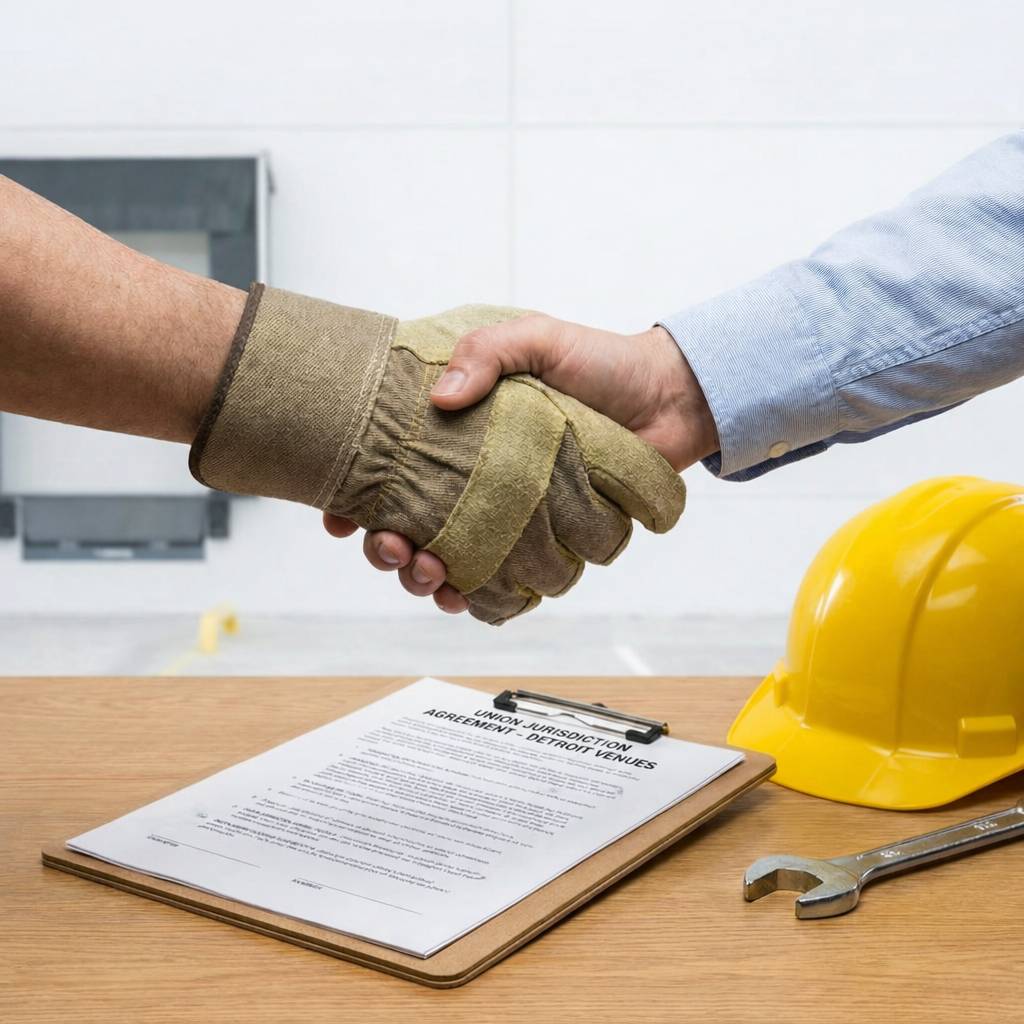
Major U.S. event facilities operate under union agreements, with specific jurisdictions governing trade show operations. Labor rules vary by city; while many venues allow self-setup for smaller linear booths, always consult the Exhibitor Services Manual (ESM) for the specific city’s union regulations.
The main unions you’ll encounter include:
- Teamsters: All freight handling, material delivery from dock to booth
- Carpenters/UBCJ: Booth assembly, pipe and drape, floor covering installation
- Electricians/IBEW: All electrical connections, under-carpet wiring, static lighting
- Stagehands/IATSE: Rigging, overhead signs, theatrical elements, audio-visual setup
What Exhibitors Can Generally Do Themselves
Most Tier-1 convention centers allow exhibitors to perform their own work in smaller linear booths (typically under 200-500 square feet, depending on the city) using hand tools only. Always verify the specific threshold in your venue’s ESM.
What you CAN typically do yourself:
- Assemble pop-up displays and modular booth components
- Install your own graphics using Velcro, magnets, or clamps
- Arrange furniture and product displays
- Set up retractable banner stands
- Plug standard equipment into provided outlets
Many trade show booths are designed for hassle-free setup that is completely tool-free and intuitive. Portable trade show displays are engineered for speed and simplicity, allowing for a smooth, stress-free setup process.
You CANNOT do without union labor (in most jurisdictions):
- Use power tools (corded drills, saws)
- Run electrical cables under carpet
- Hang signs from the ceiling or rigging points
- Use forklifts, pallet jacks, or motorized equipment
- Install carpet or flooring rolls
- Perform any electrical work beyond plugging in equipment
The “10×10 exemption” varies by city: a full-time employee of the exhibiting company can often set up a standard inline booth if the work can be completed within about 30 minutes to one hour without power tools. Verify this rule in your specific venue’s ESM before assuming it applies.
Hand-Carry Rules: Activity Breakdown
| Activity | DIY Allowed? | Requires Union? | Notes |
|---|---|---|---|
| Setting up retractable banners | ✅ Yes | ❌ No | Standard booth allowance |
| Velcro/magnetic graphics | ✅ Yes | ❌ No | No tools required |
| Arranging product displays | ✅ Yes | ❌ No | Within your booth space |
| Plugging in laptops/monitors | ✅ Yes | ❌ No | Into provided outlets |
| Hanging signs from ceiling | ❌ No | ✅ Yes (Riggers) | Exclusive union jurisdiction |
| Screwing into booth walls | ❌ No | ✅ Yes (Carpenters) | Power tools restricted |
| Running under-carpet cables | ❌ No | ✅ Yes (Electricians) | IBEW jurisdiction |
| Moving freight from dock | ❌ No | ✅ Yes (Teamsters) | Material handling |
Hand-Carry Specifics
The hand-carry rule lets you move your own materials from designated entry points using a personal two-wheel cart. But there are strict limits:
Hand-carry IS permitted for:
- Items you can carry personally or move with your own two-wheel handcart
- Materials transported from POV (Privately Owned Vehicle) loading areas or front exhibit hall doors
- Multiple trips as needed
Hand-carry is NOT permitted for:
- Using venue-owned carts, dollies, or equipment
- Using motorized vehicles of any kind
- Items requiring forklifts, pallet jacks, or mechanical assistance
- Materials on shipping pallets
Any freight beyond hand-carry scope must use the official material handling contractor (drayage), which uses union labor.
Labor Cost Management Strategies
Union labor costs can add up quickly, but strategic planning helps control expenses:
- Pre-order labor by the advance deadline (usually 30 days before the show). Floor orders placed on-site often incur 30%+ surcharges.
- Schedule for “Straight Time” hours: Monday through Friday, 8:00 AM to 4:30 PM. Evening, weekend, and holiday work bills at overtime (1.5x) or double time (2.0x) rates.
- Prepare your booth components before labor arrives: Have crates properly labeled, assembly instructions ready, and tools organized. Good planning cuts billable hours.
- Consider an Exhibitor Appointed Contractor (EAC): For complex custom trade show displays with technology or innovation features, an EAC can supervise the union crew, ensuring efficient work and preventing costly mistakes. Note that EACs must submit a Certificate of Insurance (COI) typically 30 days in advance.
The EAC Option: Exhibitor Appointed Contractors
For custom displays requiring specialized installation, exhibitors may hire their own labor—an Exhibitor Appointed Contractor (EAC)—rather than using the venue’s General Service Contractor (GSC). This option provides more control over installation quality and potentially lower costs for complex builds.
EAC requirements typically include:
- Certificate of Insurance (COI): Submit proof of liability insurance (usually $1-2 million minimum) 30 days before the show
- Union compliance: EAC workers must either be union members or work alongside union supervision, depending on venue rules
- Advance registration: Register your EAC with show management before move-in
- Proper credentials: EAC personnel need exhibitor badges and may require separate contractor badges
When to consider an EAC:
- Custom-fabricated displays requiring specialized assembly knowledge
- Technology integrations (LED walls, interactive displays, complex AV)
- Displays touring multiple shows where consistent installation is critical
- Situations where GSC labor rates exceed your budget
Always verify EAC policies in the Exhibitor Services Manual, as rules vary significantly by venue and show.
Best Materials for Indoor Convention Lighting
Convention centers use powerful overhead lighting—usually high-bay LEDs or metal halide fixtures—that creates specific challenges for signage visibility. Glossy surfaces reflect these lights and create hot spots that obscure your message.
The glare problem: Glossy vinyl banners create bright reflections under convention lighting. This makes text hard to read from certain angles. Attendees walking past may see glare instead of your message, and photos taken at your booth often have “flashback.”
The matte solution: Matte vinyl spreads light out rather than reflecting it. This keeps brand colors rich and text readable from all angles. The slightly textured surface also hides minor scratches and marks that happen during transport.
| Factor | Glossy Vinyl | Matte Vinyl |
|---|---|---|
| Light reflection | High glare, hot spots | Diffused, minimal glare |
| Readability | Angle-dependent | Consistent all angles |
| Photography | Flash reflection issues | Clean photos |
| Scratch visibility | Shows marks | Conceals imperfections |
| Indoor recommendation | Not recommended | Preferred choice |
| Outdoor use | Good for weather resistance | May fade faster |
For indoor trade shows nationwide, matte finish vinyl is the industry standard. Reserve glossy materials for outdoor events where glare is less problematic and color vibrancy benefits from direct sunlight. For outdoor events, consider weather resistant materials designed for extended exposure.
Material Weight Considerations
Vinyl banner weight affects how long it lasts and how easy it is to handle. When ordering from a custom fabrication shop or print vendor, pick the right weight for your needs:
- 13oz Scrim Vinyl: Standard for most hanging banners, good durability, flame-retardant options widely available
- 15oz/18oz Blockout: Used for double-sided signs to prevent image shadowing
- Mesh Vinyl: Reduces weight for very large banners, less common indoors
For tension fabric displays and SEG (Silicone Edge Graphics) lightboxes, fabric graphics offer a high-end look with wrinkle-resistant properties—but ensure all fabric materials meet NFPA 701 requirements. High-quality graphics and interactive features are key elements that make a trade show display visually engaging and effective. Quality materials bring your art and brand to life on the show floor.
Expo Exhibits and Booth Packages: Finding the Right Trade Show Solution
When selecting exhibit solutions for your business, consider whether to invest in custom booths, rental options, or booth packages that combine multiple elements.
Custom booths provide businesses with a competitive edge by offering unique brand differentiation, increased visitor engagement, and higher, more targeted lead generation. Custom displays are built from a “blank slate,” allowing brands to fully reflect their philosophy through specific materials and consistent color palettes.
Booth packages bundle essential components—backwall, counter, lighting, and graphics—into cost-effective solutions for exhibitors who want a professional presence without designing from scratch. Many booth packages are available in various sizes to accommodate different booth sizes and show requirements.
Rental options work well for businesses testing the trade show circuit or attending one-off events. Durable, well-built displays are designed for reuse across multiple events, reducing long-term rental and replacement expenses.
Trade show displays should be versatile, easy to assemble, and durable to withstand multiple uses. Portable trade show displays can be used multiple times across different events, making them a cost-effective investment. Many displays are designed to split seamlessly into smaller configurations for maximum flexibility across different shows.
Ordering Your Custom Trade Show Displays: Timelines & Logistics
Recommended timeline:
- 8-10 weeks out: Finalize designs, order custom signage
- 6 weeks out: Confirm fire-retardant certifications with vendors
- 4 weeks out: Ship to advance warehouse (ensures on-time delivery)
- 2-3 weeks out: Direct-to-site shipments arranged for specific move-in windows
- 5-7 business days out: Verify all tracking, confirm labor orders
Starting early helps you meet expectations and avoid last-minute stress before your next event. Your clients and sales team will thank you when everything arrives on time. Many vendors offer fast turnaround options for rush orders, though material choices may be limited.
Advance Warehouse vs. Direct-to-Show
Understanding the national shipping standard helps you avoid costly wait-time fees at loading docks:
Advance Warehouse: The General Service Contractor (GES, Freeman, Shepard) operates a warehouse that accepts freight weeks before the show. They gather all shipments and deliver to your booth before you arrive. Drayage fees apply, but this ensures materials are in place and eliminates wait time at the dock.
Benefits:
- No dock wait-time fees
- Materials delivered to booth before you arrive
- Reduced stress during move-in
- Lower risk of lost or delayed shipments
Direct-to-Site: Ship directly to the venue during assigned Target Move-In dates. Trucks must check in at the Marshaling Yard before receiving dock assignments. Arriving outside your assigned window may result in refusal or penalties.
Labeling requirements: All shipments must include:
- Exhibitor company name
- Booth number
- Show name
- Arrival dates per contractor specifications
Working with a reliable supply chain and clear labeling prevents lost shipments and last-minute scrambles.
Frequently Asked Questions
Do trade show banners need to be fire retardant?
Yes. All major U.S. convention venues require flame-retardant certification for banners, drapes, signs, and decorative materials. The NFPA 701 standard applies nationwide, and Fire Marshals can perform field flame tests on any suspect material. You must have either an NFPA 701 compliance tag sewn into the fabric or a paper certificate from the manufacturer available on-site. Non-compliant materials will be removed right away.
What is the difference between standard and fire retardant vinyl?
Standard vinyl can ignite readily, spread flame, and melt—making it a fire hazard. Fire-retardant vinyl contains chemical additives that cause it to self-extinguish and char rather than sustaining combustion. FR vinyl looks identical to standard vinyl but is made to meet NFPA 701 fire safety standards. For trade shows across the U.S., FR vinyl is mandatory; standard vinyl is prohibited.
Can I set up my own trade show booth?
Generally yes, if your booth falls within the self-setup threshold for that venue (typically 200-500 square feet for linear booths) and you’re not using power tools. Exhibitors can usually assemble pop-up displays, install graphics, arrange furniture, and plug in standard equipment using cordless hand tools. However, hanging overhead banners, running electrical cables, using power tools, or rigging from the ceiling requires union labor in most jurisdictions. Always consult the Exhibitor Services Manual for venue-specific rules.
Should I use glossy or matte vinyl for trade show banners?
Always choose matte vinyl for indoor trade shows. Convention centers use bright overhead lighting that creates glare on glossy surfaces, making text unreadable from many angles and ruining photographs. Matte vinyl spreads light out, making sure your message stays visible under any lighting. Glossy vinyl is better reserved for outdoor applications where glare is less problematic.
How do I choose the right trade show display for my business?
Consider your booth size, budget, and how many events you’ll attend. An 8ft booth works for startups, a 10ft booth suits most mid-sized companies, and a 20ft booth provides premium space for larger enterprises. For businesses attending multiple events, modular portable exhibits offer the best value since they can be reconfigured for different booth sizes and reused across shows.
What are the hand-carry rules for trade shows?
You can transport materials you can carry yourself or move with your own two-wheel handcart from designated POV areas or front exhibit hall doors. You cannot use venue-owned carts, dollies, forklifts, or motorized equipment. Any freight requiring mechanical handling must go through the official material handling contractor (drayage), which uses union labor.
When do I need union labor?
Union labor is typically required for: hanging signs from the ceiling (riggers), running electrical cables or making connections beyond standard plugs (electricians), using power tools for assembly (carpenters), moving freight from loading docks (teamsters), and installing carpet or flooring (carpenters). Larger booths and all island booths usually require union help. Specific thresholds vary by city—always check your Exhibitor Services Manual.
What is an Exhibitor Appointed Contractor (EAC)?
An EAC is a labor contractor you hire directly (rather than using the venue’s General Service Contractor) to install your custom display. EACs must submit a Certificate of Insurance (typically $1-2 million liability) 30 days before the show and comply with union requirements. This option works well for complex custom builds, technology integrations, or displays touring multiple cities where consistent installation quality matters.
Order Custom Trade Show Banners and Event Signage
If you’re preparing for a trade show, conference, or promotional event, professional signage can make a major difference in booth visibility and brand recognition.
Printastic offers a wide range of custom signs and banners designed for high-impact marketing displays, including retractable banner stands, vinyl banners, table covers, and backdrops.
Our printing process delivers:
- Vibrant, high-resolution graphics
- Durable materials designed for repeated use
- Custom sizes and formats to match your display needs
- Affordable pricing with quick turnaround times
From small tabletop displays to large event banners, Printastic helps businesses and organizations create signage that captures attention and communicates clearly.
Get started today by requesting a quote for your custom trade show displays and banners.
Disclaimer
This guide is for general info only and is not legal advice. Laws, regulations, and venue policies vary by jurisdiction and change over time. Exhibitors should check current rules with show management, venue authorities, and the Exhibitor Services Manual for each specific event. For questions about union labor, fire safety permits, or venue rules, contact the Event Manager or General Service Contractor for your show.
Author & Content Transparency
We are committed to publishing helpful, accurate, and trustworthy content that supports exhibitors and reflects industry expertise. Some content is created or enhanced using AI-assisted tools to streamline structure or improve clarity—but every piece is thoroughly reviewed, fact-checked, and edited by knowledgeable team members with real-world experience in custom printing and signage.
We do not rely on automation alone. Our content is guided by human expertise, based on reliable sources, venue-specific regulations, and customer insights. Whether you’re reading a product guide, a how-to article, or a signage recommendation, you can trust that it’s been crafted with care and a focus on delivering real value.