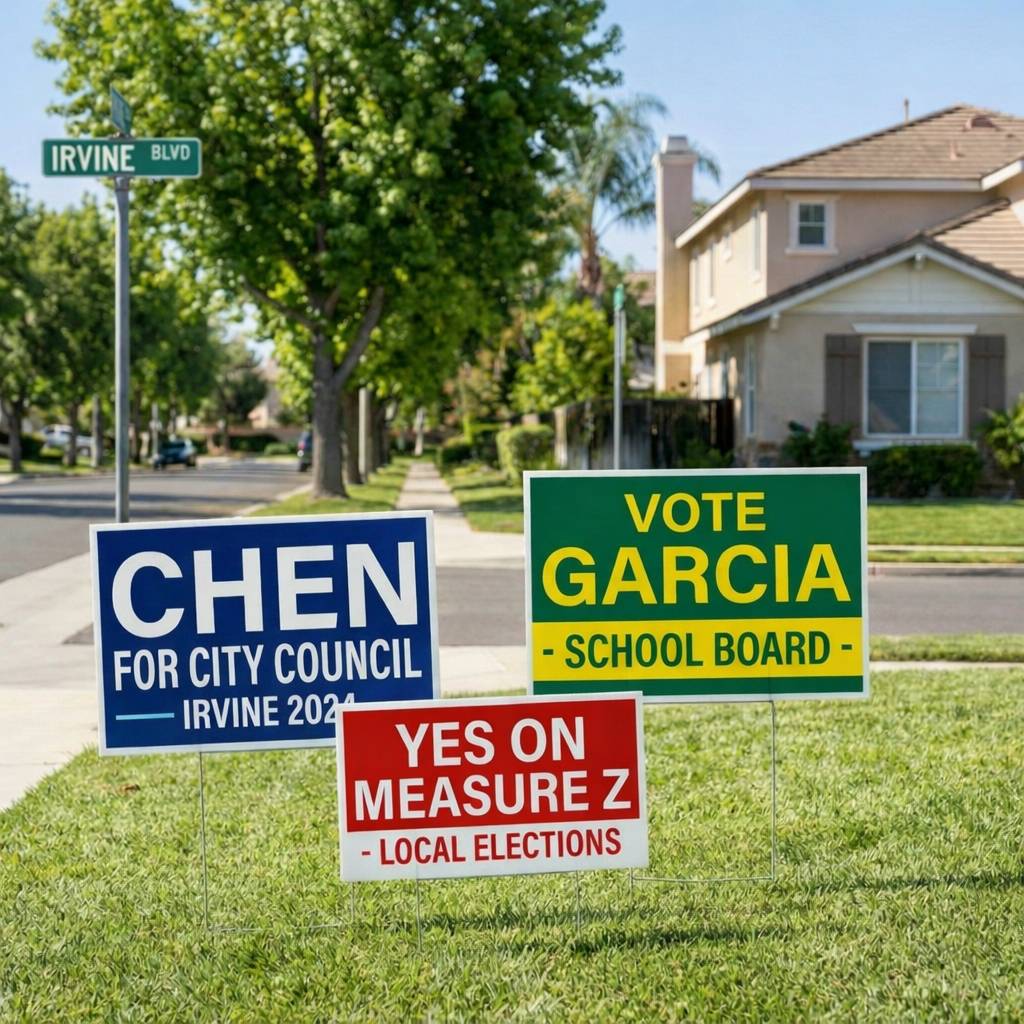
Political yard signs in Irvine, CA are a vital tool for 2026 candidates in Districts 1, 5, and 6. Following Ordinance No. 24-23, temporary signs may be displayed starting 60 days before Election Day and must be removed within 10 days post-election (City of Irvine’s sign regulations). Per City Sign Type #107, no permit is required for these non-commercial displays. While the standard 18″x24″ Coroplast sign is most common, Irvine allows for larger 12 sq. ft. displays when placed 150+ feet from intersections. Notably, California Civil Code § 4710 protects the rights of residents to display these signs even within Irvine’s many HOA-governed neighborhoods.
Why Political Yard Signs Still Dominate Irvine Elections in 2026
Political yard signs remain a cornerstone of local campaigns because they convert everyday commutes into name-recognition opportunities. Lightweight and easy to produce, they are one of the cheapest forms of political advertising available — and in low-information races where voters may not deeply research down-ballot candidates, a well-placed sign can be the difference between a win and a loss. Every impression matters, and no other medium delivers that visibility at this price point.
How do yard signs influence voter behavior in local elections?
In local races like Irvine city council or school board contests, voter awareness of candidates is often limited before Election Day. A meta-analysis of four field experiments published via Cambridge University Press found that yard sign deployment can increase a candidate’s vote share by approximately 1.7 percentage points. In tight municipal races decided by margins of 1–2 percent, that effect is potentially decisive.
The mechanism is primarily name recognition, not persuasion. Signs signal organizational capacity and community support — what political scientists call “social proof.” Veteran Orange County campaign consultant Eileen Padberg describes yard signs as a “subliminal message” that helps voters recall a candidate’s name when they reach the ballot, noting that signs function most powerfully alongside mailers, brochures, and canvassing (Voice of OC, “The Science of Signs,” May 23, 2010).
Yard signs are also versatile in their distribution. They can be handed out during neighborhood canvassing, ordered through campaign websites, and distributed at rallies — making them a practical asset for political candidates at every stage of their outreach, from local city council races to statewide campaigns. Their lightweight construction means volunteers can easily carry and install them across target neighborhoods without specialized equipment.
What makes political yard signs effective for Irvine’s demographic?
Three structural features of Irvine make physical signage especially potent. First, Irvine is a master-planned city built around high-capacity arterial roads — Jamboree Road, Culver Drive, Alton Parkway, and Irvine Boulevard — that funnel tens of thousands of vehicles daily (City of Irvine Traffic). Commuters experience extended dwell times at signalized intersections, giving strategically placed signs thousands of daily impressions.
Second, Irvine’s high concentration of HOA-governed communities is not the barrier candidates often assume. Under California Civil Code Section 4710 (Davis-Stirling Act), HOAs are prohibited from banning non-commercial political signs on a homeowner’s separate interest property. While HOAs may restrict size (up to 9 sq ft) and materials, they cannot impose content-based prohibitions. This legal protection opens Irvine’s most affluent residential villages to campaign signage.
Third, the U.S. Census Bureau reports Irvine’s average commute time at 24.7 minutes, creating repeated daily exposure to roadside signage. Multi-generational households, common in Irvine, include older high-propensity voters who respond strongly to physical advertising.
Irvine Political Sign Regulations: What Candidates Need to Know
Compliance with Irvine’s sign ordinance is non-negotiable. The city actively enforces its code — violations result in sign confiscation, removal costs billed to the campaign, and potential misdemeanor charges. Campaign signage in Irvine are primarily governed by the City’s Zoning Ordinance (Division 7), specifically under Sign Type #107 Temporary Non-Commercial Signs. Understanding the rules before you order is the first step in any sound campaign marketing strategy.
When can political yard signs be displayed in Irvine?
According to the City of Irvine Informational Bulletin on Sign Type #107, temporary political signs may be installed no earlier than 60 days prior to an election and must be removed no later than 10 calendar days after the election.
| Election | Election Date | Signs May Go Up | Signs Must Come Down | VBM Ballots Mail |
|---|---|---|---|---|
| California Statewide Direct Primary | June 2, 2026 | ~April 3, 2026 | June 12, 2026 | May 4, 2026 |
| Irvine General Municipal Election | November 3, 2026 | ~September 4, 2026 | November 13, 2026 | ~October 5, 2026 |
Note: The June 2, 2026 primary covers state-level offices; Irvine’s municipal races (Mayor, Districts 1, 5, and 6) are on the November 3, 2026 ballot. California Civil Code Section 1940.4 provides tenants a protected display window beginning 90 days before an election — candidates may extend reach by coordinating with tenant-occupied households under this state law (California Tenants Political Sign Rights).
What are the size and placement restrictions for Irvine yard signs?
Under Irvine Sign Type #107, size limits depend on placement zone. Signs may be placed in the public right-of-way or on private property with the owner’s consent — but never on City traffic signs, signals, devices, trees, shrubs, or any objects in the public right-of-way.
| Location | Max Size | Max Height | Notes |
|---|---|---|---|
| Private property (residential) | 12 sq ft | 20 ft (wall-mounted) | Standard 18″×24″ = 3 sq ft; fully compliant |
| Public right-of-way, >150 ft from intersection | 12 sq ft | 6 ft | Max-dimension placements here |
| Public right-of-way, within 150 ft of intersection | 3 sq ft (18″×24″) | 3 ft | Most restrictive zone |
| Near freeway (Caltrans right-of-way) | Prohibited | N/A | See California Outdoor Advertising Act |
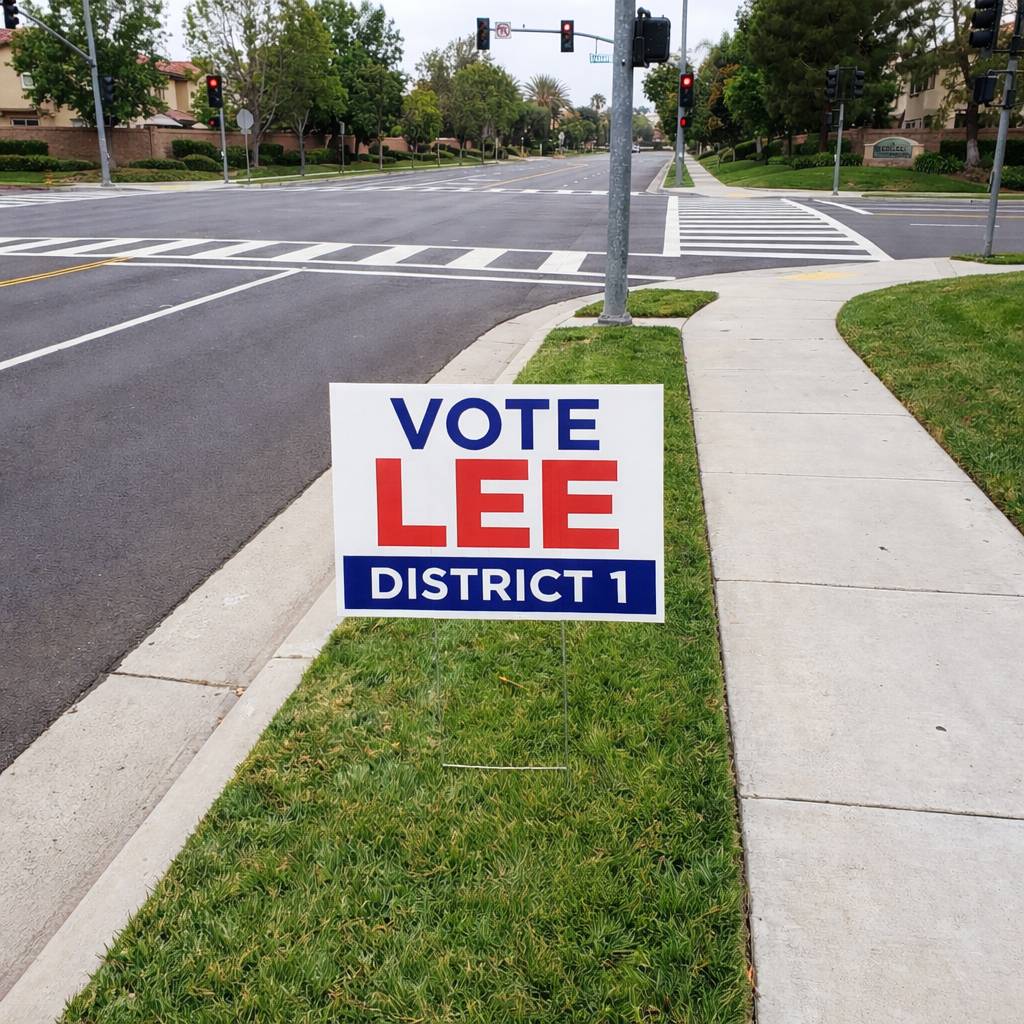
Within 150 feet of an intersection, signs are limited to 3 square feet in area and 3 feet in height. Beyond 150 feet, signs can be up to 12 square feet and 6 feet in height in the right-of-way — or up to 12 square feet and 20 feet above grade for wall-mounted signs on private property. Signs must remain outside sight-distance triangles at intersections, must not impede pedestrian or bicycle access, and must comply with ADA clearance requirements. The city limits placement to one substantially similar sign per corner per candidate, capping intersection density at four total signs per intersection.
Signs are strictly prohibited on street medians, center dividers, roadway islands, utility poles, traffic signals, trees, shrubs, or any City property (City of Irvine Signs). Political non-commercial signs should also be verified to ensure they are placed entirely on private property and not in any city-maintained easement — a common error that results in city removal at the campaign’s expense.
Do I need a permit for political yard signs in Irvine?
No permit is required for temporary political signage operating within the size and time constraints of Sign Type #107 (Irvine Sign Bulletin). This allows campaigns to mobilize rapidly without waiting for city approval. However, “no permit required” does not mean “no rules.” Violations allow the City to remove signs and recover all costs from the candidate or organization.
📋 Before you order your campaign signs, make sure you can answer these:
- Do you know your exact race type and district boundaries—and are all placements restricted to that district?
- Have you verified HOA restrictions in your target neighborhoods (size limits, materials, placement rules)?
- Are all planned sign locations confirmed to be on private property and not within city-maintained easements?
- Have you calculated the right quantity using the 1 sign per 100 registered voters baseline?
- Will your order arrive at least two weeks before the legal placement window opens?
- Do you have enough volunteers to handle distribution and installation efficiently across your target areas?
- Have you reserved 15–20% of your inventory for replacement due to theft or weather damage?
- Is there a clear plan to remove all signs within 10 days after Election Day to avoid fines or penalties?
Material & Design Specifications for Orange County Weather
Irvine’s climate presents specific challenges for outdoor signage: intense UV radiation from 280+ sunny days per year, Santa Ana wind events reaching 50+ mph in fall, and coastal moisture. Selecting the right materials and hardware ensures custom yard signs stay visible and sharp for the full 60-day deployment window without fading or collapsing.
Which material lasts longest in Irvine’s climate?
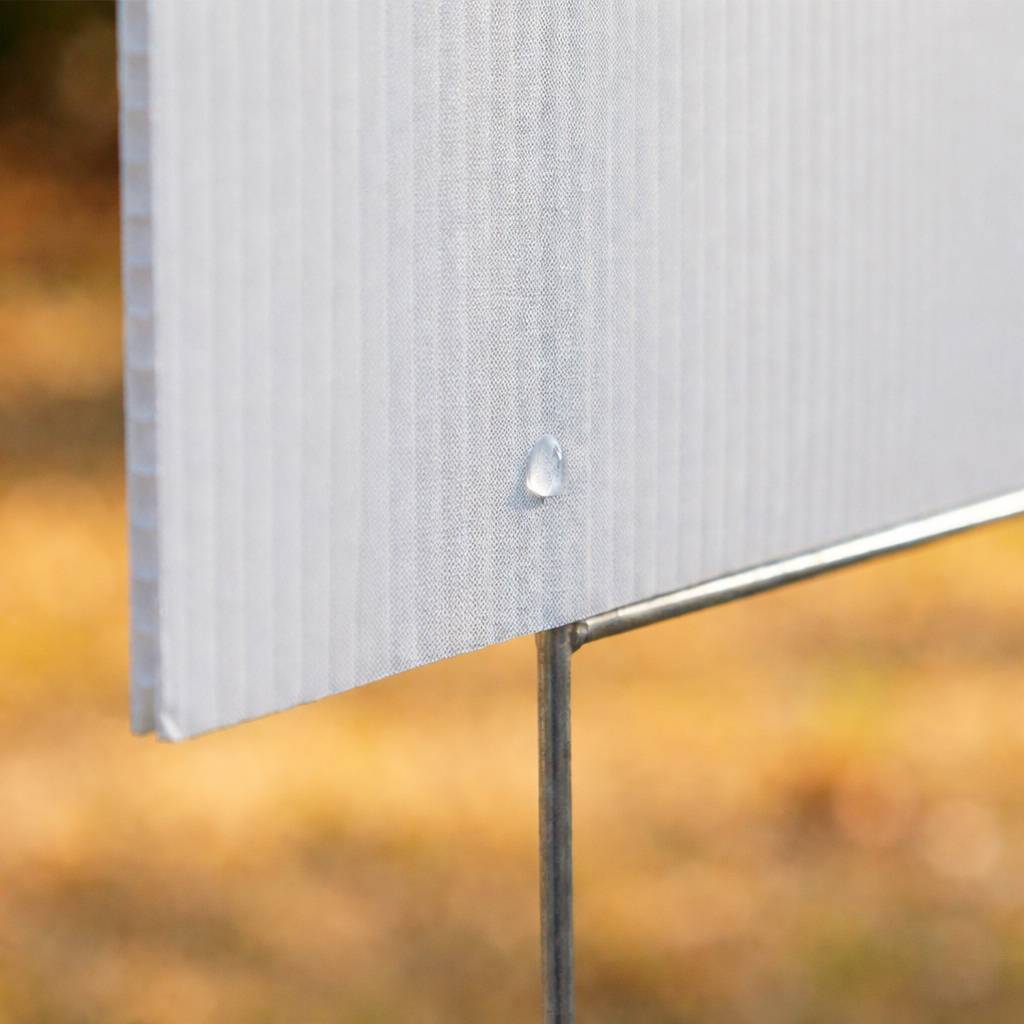
Yard signs can be made from several weather-resistant materials to suit different design needs and budgets — but the industry standard for political campaigns is corrugated plastic (Coroplast), an extruded twin-wall polypropylene sheet that is lightweight, waterproof, and impact-resistant. Standard thickness is 4mm, which balances cost with adequate rigidity for 18″×24″ residential placements. For larger formats (24″×36″ or 48″×96″), 6mm or 10mm thickness is required to prevent buckling.
For Southern California’s intense UV exposure, specifying UV-cured inks or a UV clear-coat treatment is essential for campaigns running the full 60-day window. Standard inks will fade, crack, or lose saturation within weeks under direct sun. The EPA maintains monthly UV index data confirming the high UV load in Orange County year-round. Full color signs produced with UV-resistant inks ensure the candidate’s branding remains sharp and vibrant through Election Day.
Yard signs can also include a metal stand to keep the message upright and visible in all conditions. 9-gauge galvanized steel H-stakes outperform thin-gauge wire frames in Irvine’s fall wind conditions — the H-frame geometry distributes wind resistance across two soil insertion points, preventing rotation or tearing during Santa Ana events. When ordering, confirm stake orientation matches your sign’s flute direction.
What size political yard sign gets the most visibility?
Sign size selection is a function of placement zone, traffic speed, and city code compliance. The 18″×24” format dominates because it satisfies all three considerations simultaneously.
| Size | Typical Use | Visibility Range | City Code Fit |
|---|---|---|---|
| 18″×24″ (3 sq ft) | Residential front yards, intersections | Up to 70 feet | Compliant everywhere, incl. within 150 ft of intersection |
| 24″×18″ horizontal (3 sq ft) | Candidates with long surnames | Up to 70 feet | Same compliance as 18×24 |
| 24″×36″ (6 sq ft) | High-traffic arterials >150 ft from intersections | 100+ feet at 50 mph | Compliant in right-of-way >150 ft; on private property |
At 50 mph, a driver has approximately 1.5 seconds to read a sign. The standard legibility rule: 1 inch of letter height per 10 feet of viewing distance. A sign read from 50 feet requires primary text at least 5 inches tall. Trade sources on campaign signage identify the 18″×24″ as the most popular size across political campaigns — and in Irvine, it is the only format compliant everywhere, including within 150 feet of high‑volume intersections.
How should candidates design yard signs for maximum impact?
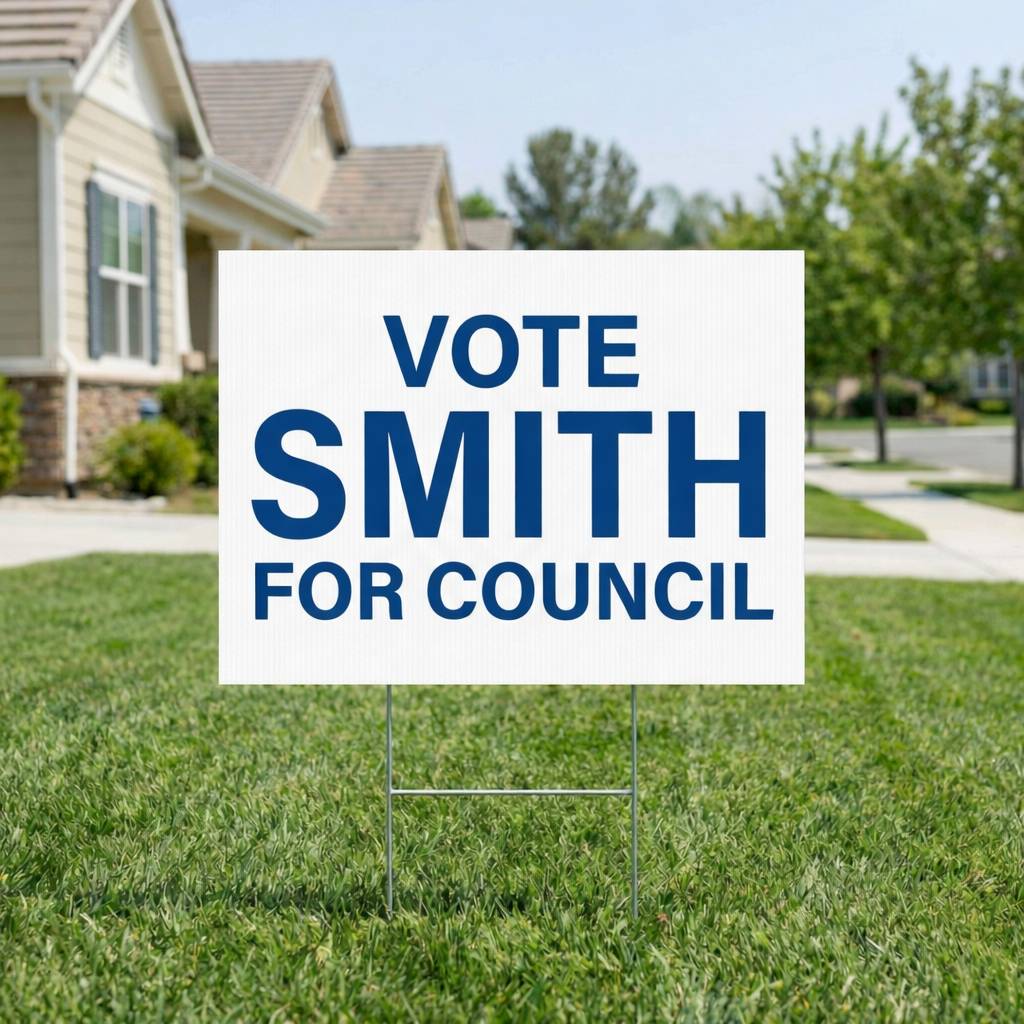
The most common design failure is textual clutter. Yard signs are name-recognition instruments, not policy platforms. Research on roadside sign recall demonstrates that 3-word configurations (e.g., “SMITH FOR COUNCIL”) yield significantly higher instantaneous recall than 7-word alternatives. The human visual cortex processes 3–4 typographic blocks in the 1.5-second dwell window at urban driving speeds — additional text actively diminishes name recall and reduces visual punch.
Campaigns & Elections magazine recommends testing font sizes by printing and stepping back to simulate real-world reading distance. Use heavy sans-serif fonts (Helvetica, Impact, Futura) and avoid QR codes, website URLs, or secondary slogans on the primary sign. Personal branding elements — incorporating the candidate’s signature color palette and a consistent logo — help signs come to life as a unified visual identity across all campaign materials.
On color: the operative principle in Irvine’s competitive districts is contrast against the landscape, not partisan alignment. Eileen Padberg cautions that green signs can dissolve into suburban landscaping (Voice of OC). High-contrast full color palettes — deep navy + vibrant yellow, or black + orange/white — optically separate the sign from the visual environment and signal non-partisan localism to swing voters in a desired residential or high-traffic location.
Bulk Pricing & Production Timeline for 2026 Elections
Sign procurement requires planning well ahead of the legal display window. Supply chains at commercial printers constrict sharply as election dates approach, and bulk orders take longer to produce. For the Irvine General Municipal Election, campaigns should have signs in hand before the approximately September 4 placement window opens — meaning procurement should begin no later than mid-August 2026.
How many political yard signs do I need for a competitive Irvine race?
Following Irvine’s adoption of Measure D, city council races are now district-based, while the mayoral race remains citywide at-large. The November 3, 2026 General Municipal Election covers four seats: Mayor (at-large) and Council Districts 1, 5, and 6 (City of Irvine). The candidate filing deadline for these offices is August 7, 2026 (Ballotpedia).
A commonly used heuristic is 1 sign per 100 registered voters as a baseline, with a 15–20% buffer for theft and damage (Campaign Workshop). Academic research correlates achieving this density ratio with a 0.5–1.5 percentage point increase in localized vote share.
| Race Type | Estimated Quantity | Coverage Target |
|---|---|---|
| City Council (single district) | 500–1,000 signs | District arterials + residential penetration |
| School Board or Mayor (citywide) | 1,500–2,500 signs | All residential villages + major arterials |
| Localized ballot measure | 250–500 signs | Target precincts only |
What’s the typical turnaround time for political yard sign orders?
For the November 3, 2026 Irvine General Municipal Election, the candidate filing deadline is August 7, 2026. Bulk sign procurement should be initiated immediately after filing to ensure delivery before the approximately September 4 legal placement window. For the June 2, 2026 California Statewide Primary, the state-office candidate filing period runs February 9–March 6, 2026, with the sign placement window opening April 3, 2026.
| Order Size | Turnaround | Notes |
|---|---|---|
| Under 100 units (rush) | 24–48 hours | Premium rush surcharge typically applies |
| Standard order (any size) | 5–7 business days | Mid-cycle baseline; plan around this |
| 1,000+ units (bulk) | 10–14 days | Requires flatbed press scheduling |
Local Orange County sign specialists offer prompt service and eliminate interstate freight costs for heavy Coroplast pallets and steel H-stakes. National vendors may undercut on unit cost by 15–20%, but freight charges for 1,000 H-stakes often eliminate those savings.
How much do political yard signs cost in Irvine?
As one of the most affordable forms of political advertising, custom yard signs deliver strong visibility per dollar. Bulk ordering options allow campaigns to purchase hundreds or thousands of signs at competitive prices. Pricing follows an inverse volume curve — always request all-inclusive quotes that bundle H-stakes, full-bleed printing, and setup fees. Hidden fees to watch for: artwork vectorization charges, “full bleed” surcharges, H-stake upgrades ($0.80–$1.20 per unit), and rush fees.
| Quantity | Est. Cost/Sign (18″×24″, 2-color) | EstimatedInvestment | Coverage Level |
|---|---|---|---|
| 50 units | $6.50–$8.00 | $325–$400 | Hyper-local micro-targeting only |
| 100 units | $4.50–$5.50 | $450–$550 | Small neighborhood or design testing |
| 250 units | $3.00–$4.00 | $750–$1,000 | Minimum viable for competitive district |
| 500 units | $2.25–$2.75 | $1,125–$1,375 | Full district saturation |
| 1,000+ units | $1.75–$2.10 | $1,750–$2,100+ | Citywide / maximum ROI |
Strategic Placement for Maximum Voter Reach
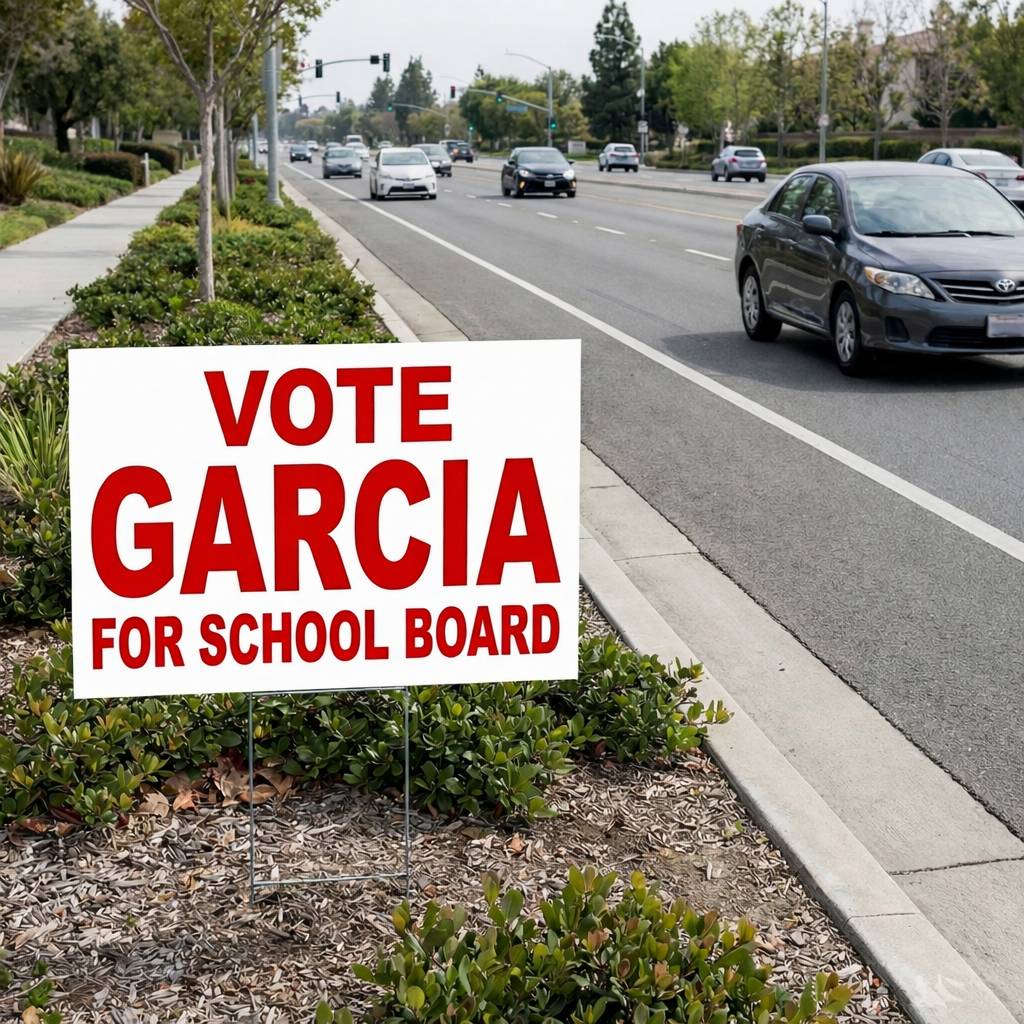
A well-designed sign on a low-traffic street is wasted campaign budget. Sign placement strategy determines whether that sign reaches 50 people or 5,000 people per day. Geographic targeting must account for traffic volume, voter density, and regulatory compliance — and it should be incorporated into the overall campaign marketing strategy from the start.
Where should political yard signs be placed in Irvine for best results?
High-traffic intersections on Irvine’s arterial grid are the primary targets. The intersection of Jamboree Road and Walnut Avenue registers among the highest traffic volumes in the city (Irvine intersection traffic data). Culver Drive at Alton Parkway and Harvard Avenue at Michelson Drive serve as critical connectors between commercial districts and residential villages. Place maximum-dimension signs (12 sq ft) just outside the 150-foot sight-distance triangle at these intersections to maximize impressions while remaining code-compliant.
Early voting locations are high-concentration targets in the final stretch — Irvine vote centers open May 5, 2026 for the June primary and approximately October 26, 2026 for the November general. City code limits signs on public city property within 250 yards of a vote center to four per candidate, during operating hours only.
District candidates: Signs for district races may only be placed within district boundaries, with limited exceptions. Map your district before ordering and before assigning volunteer placement routes.
Bandit signs — unsupported corrugated signs placed illegally on utility poles, traffic signals, or in medians — are a compliance risk that no campaign should take. The City removes them immediately and bills the campaign for recovery costs.
State highway corridors: Campaigns targeting I-5 or I-405 commuters must comply with the California Outdoor Advertising Act (Caltrans). Signs are prohibited within the state right-of-way, and signs on private property visible within 660 feet of a classified landscaped freeway require a formal Statement of Responsibility with Caltrans.
How do you secure permission for yard sign placement?
Signs may be placed on private property only with the owner’s consent. Securing documented permission protects the campaign legally and enables precise post-election retrieval. Best practice: canvassers solicit voter commitments door-to-door at each house, then immediately request lawn permission before leaving. Log each placement digitally — a shared spreadsheet with address, date, and volunteer name — for retrieval coordination.
For commercial properties abutting major intersections, campaign representatives must negotiate directly with property managers. Placing signs on vacant commercial lots without permission is illegal under California property rights law and exposes the campaign to trespassing liability.
The distribution and installation of yard signs across Irvine can be time-consuming and labor-intensive. Organize sufficient volunteer assistance to ensure proper placement — and have volunteers execute signed waivers protecting the campaign committee against inadvertent damage to irrigation lines, fiber-optic cables, or utility conduits.
Printastic’s Political Campaign Package for Irvine Candidates
Once you understand Irvine’s sign regulations, placement limits, and timing constraints, the real challenge becomes execution. Ordering the wrong size, missing the legal display window, or deploying non-compliant materials can result in wasted budget, removed signs, or lost visibility during critical campaign weeks.
Printastic works with Irvine candidates to eliminate those risks by delivering fully compliant political yard signs and campaign materials aligned with local regulations and real-world campaign timelines.
Our campaign packages are built for speed, consistency, and reliability, and typically include:
✔️ 18″×24″ and 24″×36″ corrugated plastic yard signs (code-compliant formats)
✔️ UV-resistant, full-color printing for 60-day outdoor durability
✔️ 9-gauge galvanized H-stakes matched to sign orientation
✔️ Large-format vinyl banners for rallies and campaign HQ visibility
✔️ Bulk production scheduling aligned with election deadlines
Working with a single vendor ensures consistent color, faster turnaround, and fewer coordination issues during high-pressure campaign periods. It also reduces the risk of delays, reprints, or mismatched materials across different suppliers.
If you’re preparing for the next Irvine election cycle, the safest approach is to lock in production early and ensure your signage strategy is fully compliant before deployment.
What’s included in a full-service political sign order?
A comprehensive campaign package integrates all physical media into one unified solution. This includes 4mm UV-treated Coroplast yard signs produced in full color in standard 18″×24″ and 24″×36″ formats, 9-gauge galvanized H-stakes (equal to sign count), heavy-duty vinyl banners with wind-slits and brass grommets for rally or campaign HQ deployment, and large-format 4×8-foot structural highway signs. Our clients benefit from bundling through a single local vendor — it eliminates coordination complexity, provides rapid quality-control remediation for any misprinted batches, and avoids interstate shipping delays on heavy pallets.
FAQ: Political Yard Signs in Irvine
Can HOAs prohibit political yard signs in Irvine?
No. Under California Civil Code § 4710, HOAs are legally prohibited from banning the display of non-commercial signs — including political campaign signs — on a homeowner’s separate interest property. HOAs may enforce reasonable aesthetic restrictions, such as limiting signs to materials like paper, cardboard, plastic, or fabric, and may cap size at 9 square feet.
However, HOAs cannot impose content-based prohibitions, and attempts to ban political signage under HOA covenants have routinely failed in California courts. HOA-governed common areas remain under HOA control — the legal protection applies to the homeowner’s private lot only.
What happens to yard signs after the election?
The City of Irvine mandates that all temporary political signage be completely removed within 10 calendar days after the election (City of Irvine Sign Bulletin). Failure to comply is a misdemeanor zoning ordinance violation, and the City may recover all removal, transport, and storage costs directly from the candidate or organization. Environmentally conscious campaigns should coordinate with local polypropylene recycling facilities for Coroplast disposal. H-stakes can be sanitized and stored flat for reuse in future election cycles.
Are double-sided political signs worth the extra cost?
Yes — particularly for signs placed perpendicular to roadways with bidirectional traffic. A single-sided sign is invisible to 50% of passing vehicles. Because the primary cost of a corrugated plastic sign lies in the raw substrate and press setup rather than ink volume, upgrading to double-sided printing typically adds only a 15–20% cost premium while delivering 100% more potential visual impressions. For arterial placements where traffic flows in both directions, double-sided printing is strategically mandatory.
How do I prevent sign theft in competitive races?
Sign theft is common in contested local elections. Effective mitigation strategies include placing signs deeper into private lawns rather than directly at the sidewalk edge, and reserving 15–20% of total inventory for rapid-response replacement during the final 14 days of the campaign. If organized, large-scale removals are documented, engage local law enforcement. Residential security camera footage can deter coordinated theft. Do not place signs in prohibited locations as a workaround — city removal is faster than theft recovery and generates negative campaign optics.
Can I use the same signs for multiple elections?
Yes, provided the design was built for longevity. UV-treated Coroplast on 9-gauge H-stakes will survive a 60-day deployment with minimal degradation. The key design parameter for reusability is omitting temporally specific data — dates, election cycles, or specific years.
Limiting sign text to the candidate’s surname and targeted office allows inventory to be stored flat and redeployed in future cycles. Always validate signs against current district boundaries before reuse, as Irvine’s transition to by-district city council elections affects where each candidate’s signs may legally be placed.
What are the exact display and removal dates for the 2026 Irvine elections?
For the June 2, 2026 California Statewide Direct Primary (state offices): display window opens approximately April 3, 2026; all signs must be removed by June 12, 2026. Vote-by-mail ballots begin mailing May 4, 2026; ballot drop-off locations open May 5, 2026.
For the November 3, 2026 Irvine General Municipal Election (City of Irvine Election Information) — covering Mayor and Council Districts 1, 5, and 6, with a candidate filing deadline of August 7, 2026 — display window opens approximately September 4, 2026; all signs must be removed by November 13, 2026.
These dates are derived from the 60-day/10-day rule in the City’s sign ordinance. Always verify directly with the City of Irvine before deploying.
Do Irvine political yard signs require a campaign finance disclaimer?
Potentially yes, depending on your committee type. The Federal Election Commission requires disclaimers on public communications for federal candidates. For California state and local candidates, the Fair Political Practices Commission (FPPC) regulates disclosure requirements for printed political advertisements, including large promotional signs and yard signs. The required “Paid for by [committee name]” language varies by committee type. Validate disclaimer requirements with your campaign attorney or the FPPC before printing final inventory.
Content Accuracy and Sources
This guide was prepared by the Printastic team based on publicly available municipal sign regulations and election resources. While regulations may change between election cycles, the information presented here reflects general guidance for campaign signage in California municipalities.
Primary references used in preparing this guide include:
- City of Irvine municipal sign regulations
- California election campaign guidelines
- Local campaign printing best practices used by the Printastic production team
Candidates and campaign managers should verify the latest municipal requirements before installing signage.
If you have questions about campaign sign printing, materials, or production timelines, the Printastic team can help guide you through the process.
Author
The Printastic Campaign Printing Team specializes in large-format political signage and election campaign printing. The team works with candidates and organizations to produce compliant yard signs, banners, and outdoor graphics for local and statewide elections.
Their work focuses on sign durability, readability, and compliance with municipal sign regulations, helping campaigns plan production timelines and effective sign placement strategies.
Legal Disclaimer
The information provided in this article is for general informational purposes only and does not constitute legal advice. Election laws, municipal sign ordinances, and homeowners’ association (HOA) rules may vary by jurisdiction and may change between election cycles.
Campaigns should verify current regulations directly with the City of Irvine, relevant municipal authorities, and their HOA (if applicable) before installing political signage. For legal interpretation or compliance guidance, consult a qualified election or campaign law attorney.
While the Printastic team strives to keep this guide accurate and up to date, readers are responsible for confirming the latest local requirements before deploying campaign materials.
Published: March 2026