
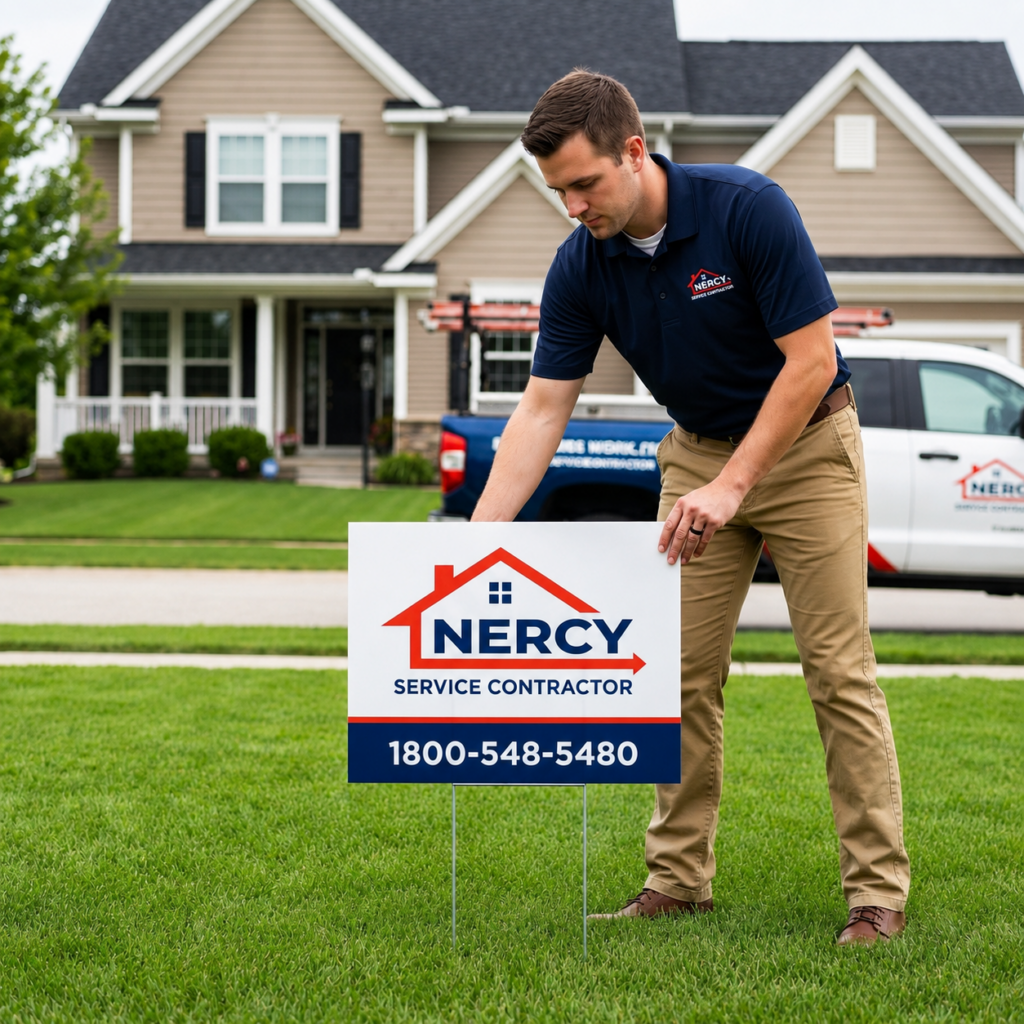
Yard sign placement for business works when signs appear where buying decisions happen — on customer properties (including active job sites), at your storefront, and on private-property corners near high-traffic routes. The most effective locations share one trait: your customer is already there, with time to notice. In most states, public right-of-way — medians, sidewalks, poles — is prohibited or permit-required.
Key Takeaways
- Yard signs work best as part of a strategic, targeted campaign — not as isolated placements
- The five strongest locations: active customer properties, high-traffic private-property corners, your storefront, customer front yards, and event routes
- 18″ × 24″ corrugated plastic yard signs are the compliant standard for most business promotions
- California local ordinances prohibit signs in public right-of-way — private property with owner permission is the legally safe path
- A branded campaign of 15–25 lawn signs in one neighborhood builds the brand awareness that drives calls
- Measure results with a dedicated trackable phone number or UTM-tagged QR code
Most business owners buy a handful of signs, stake them along the nearest busy road, and wait. The calls don’t come. They conclude yard signs don’t work — and miss the real problem: placement, design, and volume are all wrong.
Yard signs do work. They work especially well for local service businesses — contractors, landscapers, HVAC companies, real estate agents, and event organizers — because their customers are the neighbors who live and drive within a few miles of each job. Done right, a yard sign is always-on local advertising with no recurring cost after the initial print order.
This guide is the complete playbook for business owners in Irvine and Orange County, though the strategy applies anywhere in California. You’ll learn where to place signs legally and effectively, how to design them so drivers actually read them, how many you need for a real campaign, and how to tell if they’re working.
Why Yard Signs Still Work for Small Businesses in 2026
Yard signs still work because they deliver repeated, hyperlocal impressions to the same neighbors week after week — the people most likely to be a business’s next customer. Out-of-home advertising broadly outperforms most digital channels at the local level: a 2026 OAAA study found OOH delivered a median 20% lift in in-person outcomes and 14% in digital outcomes — roughly double the lift of connected TV (OAAA/Kochava, 2026). Yard signs are the most affordable, hyperlocal version of that channel.
The core advantage is repetition. Your neighborhood is your customer base. When the same people drive past your sign three or four times a week, your brand moves from unknown to familiar — and familiar businesses get the call when the need arises. A well-placed yard sign operates around the clock at no recurring cost after the initial order.
The business types where yard sign advertising tends to produce the strongest results: home services, real estate, restaurants, event promotion, and local retail. Any business whose customer base lives and drives within a few miles of each job is a good candidate.
For local advertisers and marketing managers, the appeal is straightforward: yard signs offer low-cost advertising with strong targeted geographic reach, meaningful lead generation potential, and sustained brand awareness support across local communities — without recurring monthly fees. Unlike digital ads that stop the moment the budget runs out, a compliant, impactful sign continues working until physically removed.
Choosing the Right Type of Yard Sign for Your Business
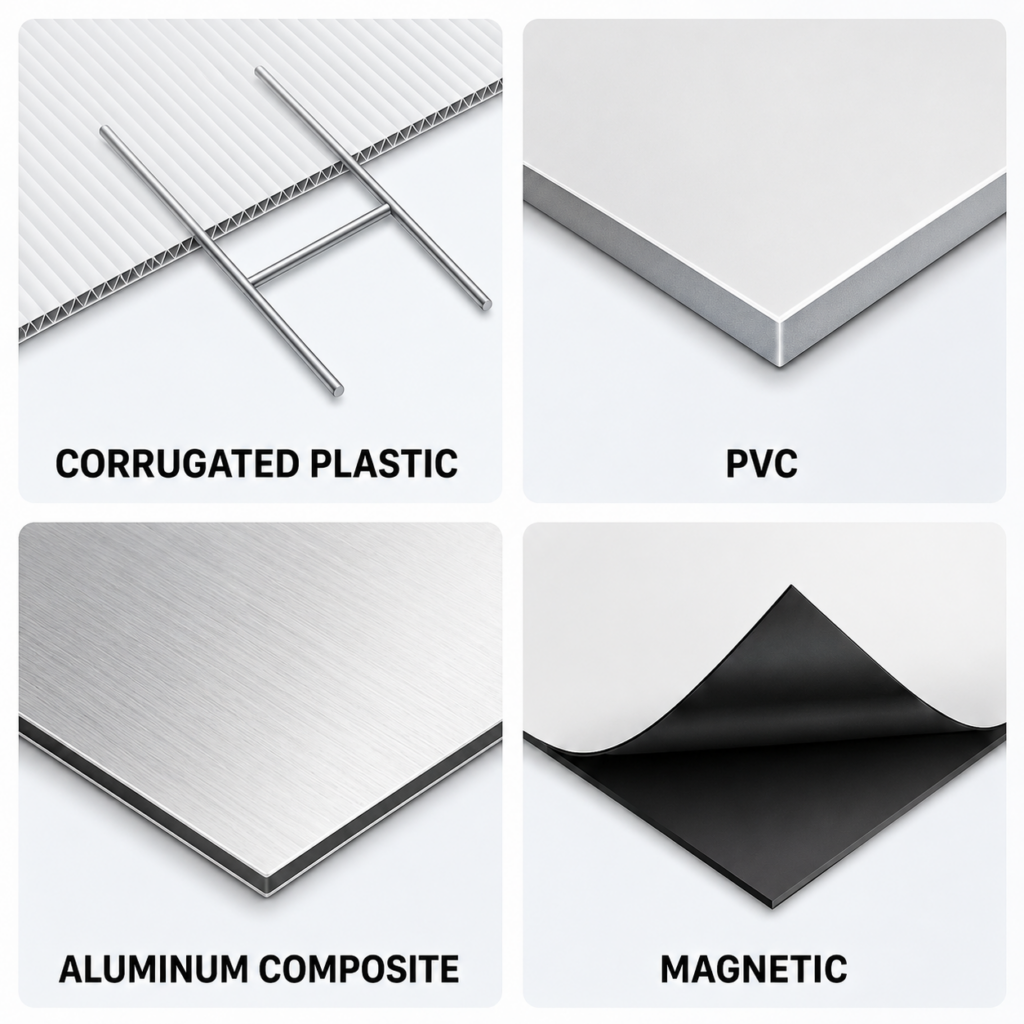
Three main materials — each with different display options, outdoor use profiles, and price points — cover most business yard sign needs:
Corrugated plastic yard signs are the standard for campaigns. Durable corrugated plastic is lightweight, weather-resistant in rain and direct sun, easy to stake with wire H-stakes or metal frames, and cost-effective at volume. Outdoor lifespan typically ranges from several months to roughly two years depending on ink quality, UV exposure, and mounting conditions. Most short-to-medium-term business promotions and campaigns use corrugated. A glossy coating or UV laminate can extend lifespan and keep colors vivid for extended outdoor life.
Printastic sells corrugated plastic yard signs only. PVC and aluminum sign panels are not part of our current product lineup — the descriptions below are provided so you can evaluate all available options and make the right choice for your use case.
PVC is the step up when a sign needs to look more polished at close range — storefronts, A-frames, entryway displays. It’s heavier, more rigid, and holds print detail well for semi-permanent outdoor use. Less suited for high-volume staking campaigns.
Sign panels (aluminum composite or rigid aluminum) are built for permanence — fence mounting, storefront hardware, or any location where a sign needs to hold up through multiple California seasons. Higher per-unit cost; significantly longer lifespan for multi-season durability.
Single vs. double-sided: double-sided printing is worth the additional cost at corner locations and high-foot-traffic areas where your sign is visible from both directions. For most lawn or job-site placements, single-sided is sufficient.
Ready to Launch Your Yard Sign Campaign?
Get durable, full-color yard signs designed for job sites, customer properties, storefronts, and local promotions. Choose your size, upload artwork, or start from a template.
What Size Yard Sign Does Your Business Need?
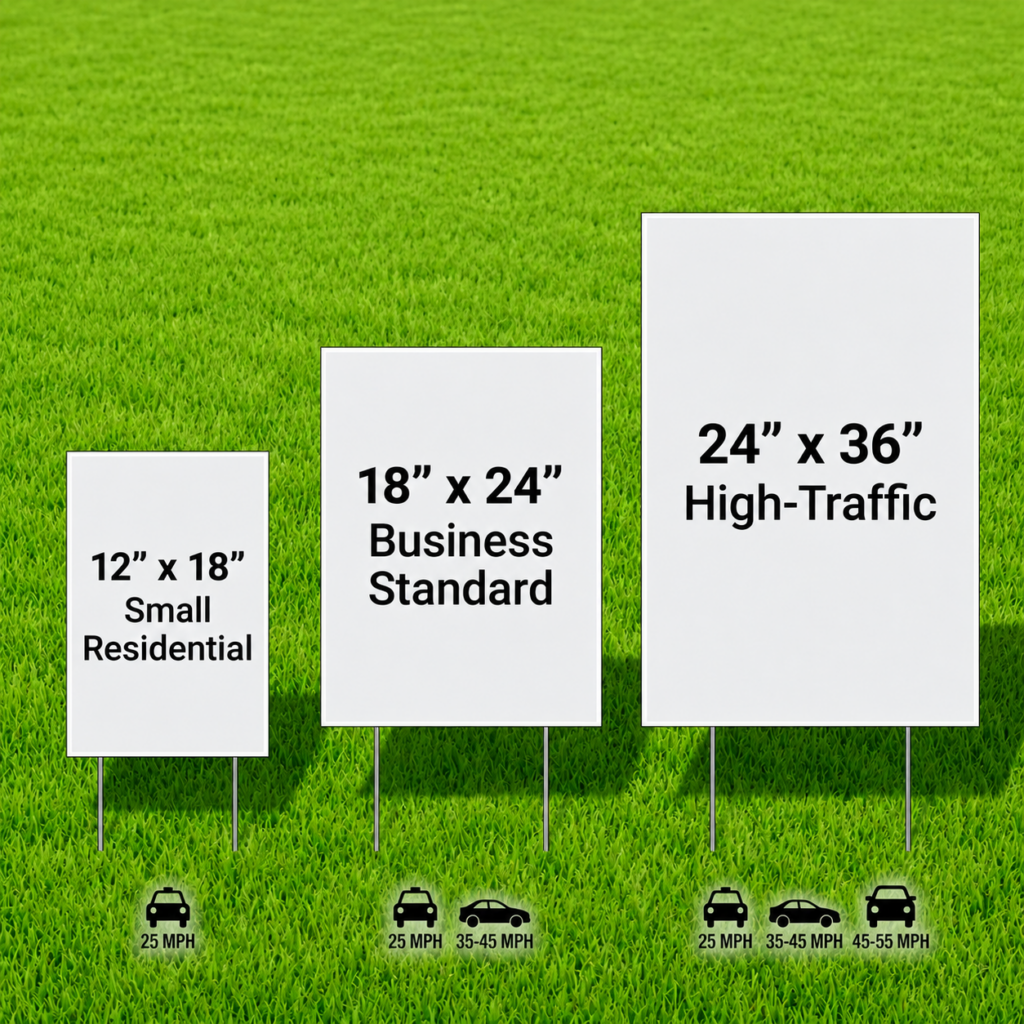
Size is a readability question, not an aesthetic one. Signs come in multiple sizes and shapes — rectangular being the standard — but the right choice is driven by viewing distance and road speed, not by what looks best on screen. The U.S. Sign Council’s legibility research gives a practical reference: approximately 30 feet of readable distance per inch of capital letter height for perpendicular roadside signs (USSC Sign Legibility Rules of Thumb). Letter size must scale with distance and traffic speed.
Three practical tiers:
- 12″ × 18″: Tight spaces, slow residential streets (under 25 mph), close-proximity placements. Limited to very short copy.
- 18″ × 24″: The small business standard. Readable at 35–45 mph with properly sized lettering. Fits standard H-stakes. Right for contractors, real estate, local promotions, and job-site visibility.
- 24″ × 36″: High-traffic arterials, faster roads (45–55 mph), grand openings, major events. Use when the sign is set back from the curb or when letter height must increase materially.
Quick decision rule: speed limit under 40 mph → 18″ × 24″ is usually sufficient. Over 40 mph → 24″ × 36″. If the road is fast enough that even 24″ × 36″ feels marginal, a larger format — banner, permanent panel — is probably the right tool.
How to Design a Yard Sign That Drivers Actually Read
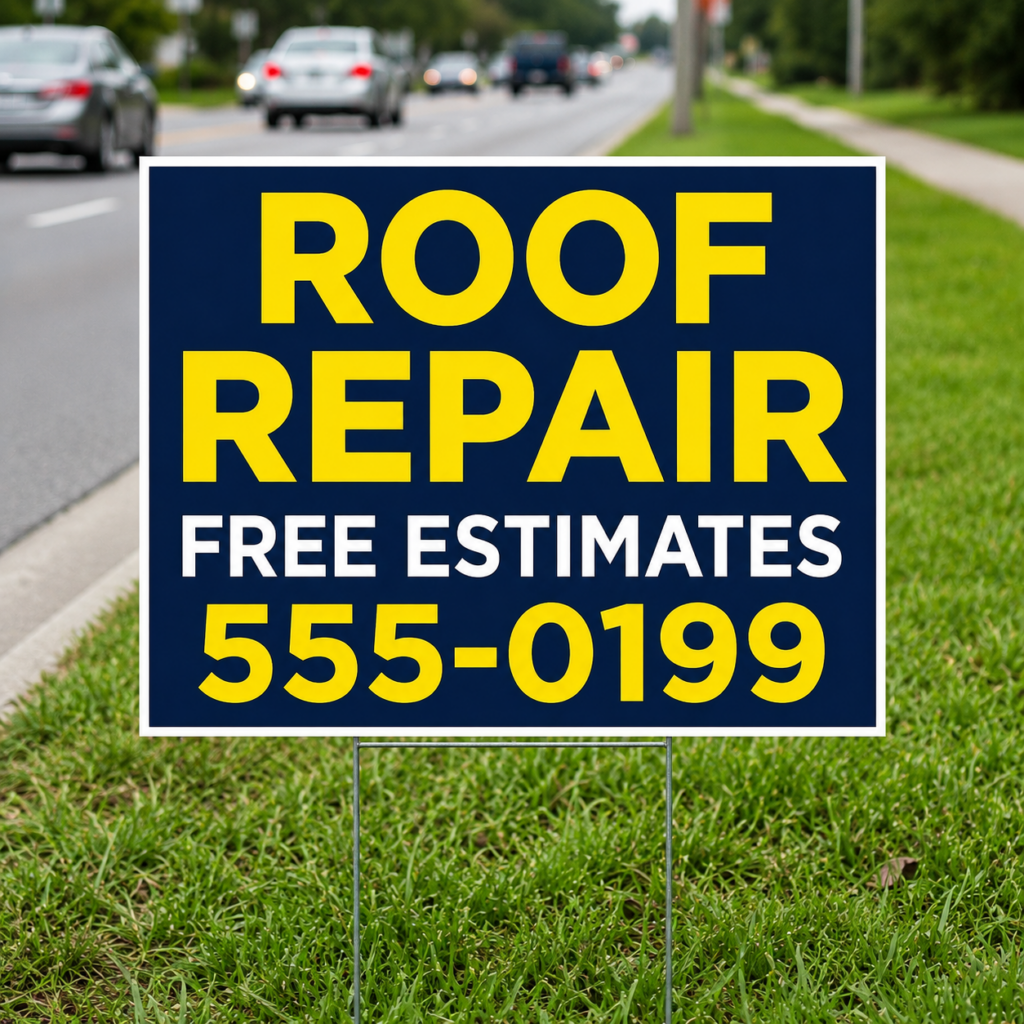
At 35 mph, a driver has roughly three seconds of visibility. Research from the Washington State Department of Transportation’s 2025 traffic operations manual indicates drivers typically comprehend about three words per second after an initial perception delay of up to two seconds (WSDOT Traffic Operations Manual, 2025). That means a passing driver may absorb five or six words before the sign disappears.
Design rules that follow from that constraint:
- Five to seven words maximum across the primary message area
- Minimum 3″ capital letter height for the headline (taller on faster roads)
- High contrast required — dark on light or light on dark: black/yellow, navy/white, red/white. An eye-catching, branded color combination outperforms a subtle palette in every field condition.
- One primary message — business name plus one service or offer; not both phone and URL unless the road is slow
- Limit images and graphics — a logo is fine; detailed images reduce readability at distance and don’t render clearly at standard corrugated print resolution
- No script fonts, pale-on-pale color combinations, or paragraph text
- QR codes only where dwell time allows — near stop signs, parking lot entries, slow residential corners
Mixed-case copy is slightly more readable than all-caps at equivalent letter height: USSC research notes that all-caps requires approximately 15% more letter height to achieve comparable legibility (USSC). If space is tight, mixed case is the more efficient choice.
Create Your Sign in Minutes
Use our online design tool to build a professional yard sign with the right size, colors, fonts, and layout for maximum roadside visibility. No design experience required.
Where to Put Yard Signs for Your Business
A strategic, targeted campaign places lawn signs and corrugated plastic signs where your best prospects already are — not where signs are merely convenient to stake. The five placement locations that tend to produce the strongest results for local service businesses, ranked by effectiveness:
1. Active customer properties. Your most powerful location. When work is underway at a property, neighbors on that street are potential customers with the same problem you’re already solving. Get written or text-message permission from the homeowner before the job starts, place the sign on day one, and keep it up for roughly two weeks after completion.
2. High traffic areas — private-property corners near your service area. Red lights pause traffic long enough — often 30 seconds or more at major intersections — for drivers to read your name, service, and number. The operative phrase is private property. Approach corner businesses near your service area and ask permission to place a branded sign on their frontage. Never stake into a median or curb strip — and never place a sign on any private-property corner without explicit owner permission and local permit confirmation.
3. Your own storefront and parking lot. The easiest legal placement — and one many businesses overlook. Sidewalk-facing signs and lot-entry signs convert walk-by and drive-by traffic with no regulatory risk when you’re on property you control.
4. Customer front yards in residential areas. Ask a satisfied customer if they’ll keep a promotional sign in their front yard for two to four weeks. One sign per street creates a social-proof signal in the neighborhood: “someone on this block already hired them.” This placement is especially effective for home services.
5. Event venues, markets, and pop-ups. Directional signs placed on surrounding roads three to five days before an event guide traffic to your booth or location. Coordinate with event organizers, and remove every sign the same day the event ends.
A note on what not to do: signs staked into public right-of-way — medians, utility poles, parkway strips, road signs, curb strips — are removed by city code enforcement across California, often without warning. The next section covers where the legal lines fall.
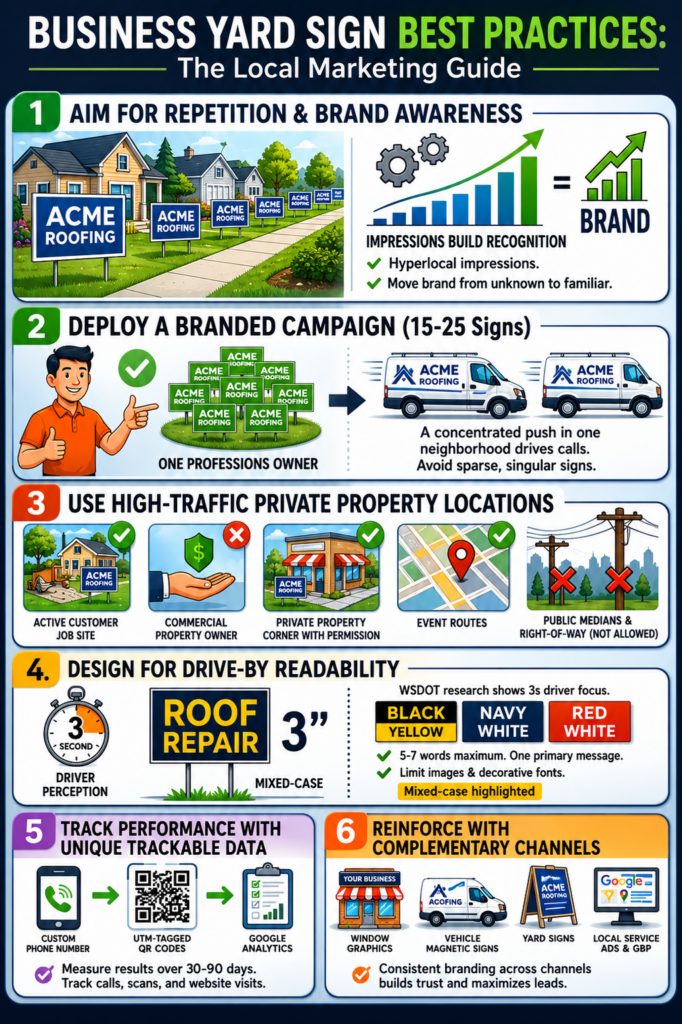
Business Yard Sign Best Practices at a Glance
Successful yard sign campaigns combine legal placement, readable design, neighborhood density, and measurable tracking. The framework below summarizes the key principles discussed throughout this guide.
Yard Sign Placement Rules in California — What You Need to Know
California placement law operates in three layers simultaneously: state highway rules, local ordinances set by each municipality, and private-property permission. None of these replaces the others — and violating any one of them can result in immediate sign removal and fines. Understanding this structure is how compliant local advertisers avoid fines and keep campaigns running.
State level. Caltrans states that placing any advertising display within state highway right-of-way is unlawful under California Business and Professions Code §5403(a) (Caltrans Maintenance Manual, Chapter 9). Maintenance crews are authorized to remove such signs and bill responsible parties for removal costs. A second state-level consideration: if a sign is on private property within 660 feet of a state highway right-of-way edge and visible from the highway, it may trigger Caltrans outdoor advertising permit requirements — a more regulated category than a simple on-site business sign.
Local level. Each municipality sets its own sign code, and restrictions in community spaces — parks, sidewalks, medians, and public property — are broadly consistent across California cities. Los Angeles Municipal Code §67.02 bars signs on sidewalks, streets, poles, hydrants, trees, and other public places (LA Municipal Code). Brea — an Orange County city — bars private temporary signs on public property entirely and requires separate city permits for any sign within the public right-of-way, with placement on city-owned light poles limited to government-sponsored events. OC Public Works has a formal sign-posting policy for unincorporated Orange County areas (OC Public Works). Irvine has its own sign ordinance governing temporary sign placement on commercial property. For residential placements, HOA guidelines may impose additional size and duration restrictions on top of city rules — check both before launching a campaign.
Private property. Across California, placing a sign on private land requires explicit consent from the property owner. A text message confirmation is generally sufficient — keep a record of it.
The operational rule. Treat road edges, medians, sidewalks, utility poles, and intersection areas as prohibited by default. Verify placement-specific rules with your local planning or code enforcement office before a campaign launches. If a placement plan depends on gray-area locations, the plan is weak.
For Irvine-specific guidance, contact the City of Irvine Planning and Building Department directly before your campaign launches.
This information is provided for general awareness. Sign regulations vary by city, county, and proximity to state highways. Verify current requirements with your local planning department and Caltrans before placing signs.
How Many Yard Signs Do You Need to See Results?
There’s no universal benchmark. Out-of-home advertising is measured by impressions, reach, and frequency — not raw unit count. What matters is whether the same potential customers encounter your branded message repeatedly in a defined area.
A practical framework: a single sign establishes that you exist. A cluster of multiple signs in one neighborhood — roughly 15 to 25 across a one-to-two-mile radius — creates the density needed for recognition to build. That range is a practical inference from OOH measurement logic rather than a published study figure.
Some service businesses rotate a set of 25 to 30 signs across 10 to 12 locations, moving placements every two to three weeks to reach fresh audiences as the campaign matures. For a marketing manager planning a seasonal push, this rotation model keeps the campaign feeling fresh without requiring new artwork on every cycle.
Budget check: a corrugated plastic campaign of 25 signs from Printastic typically costs a fraction of a single month of paid local digital advertising — with no recurring charges after the initial print order.
Yard Sign Marketing Strategies That Actually Work
The most effective yard sign strategies share one characteristic: they use signs for one narrow job. For contractors, that job is neighborhood proof. For events, it’s directional wayfinding. For retail, it’s a time-sensitive trigger. Four approaches that follow this logic:
1. Radius marketing. Cluster eight to twelve signs within three to five blocks of an active job. The implicit message — “your neighbor hired us” — is more persuasive than any tagline. The denser and more strategic the cluster, the more impactful the campaign.
2. Customer property leave-behind. Sign goes up on day one, stays approximately two weeks after project completion with homeowner permission. This is the single most effective and targeted placement in home services: a real result, a real address, real neighbors noticing.
3. Seasonal blitz. Front-load sign placement before your busy season, not during it. HVAC companies deploy signs in late spring (pre-summer) and early fall (pre-winter heating season). Landscapers push in February and March. Painters target October, before the holiday renovation period. If you wait until the busy season starts, you’ve waited too long.
4. Event cluster. For events, markets, and pop-ups — place six to ten directional signs on surrounding roads three to five days before the event. Use arrows prominently. Remove every sign the same day the event ends.
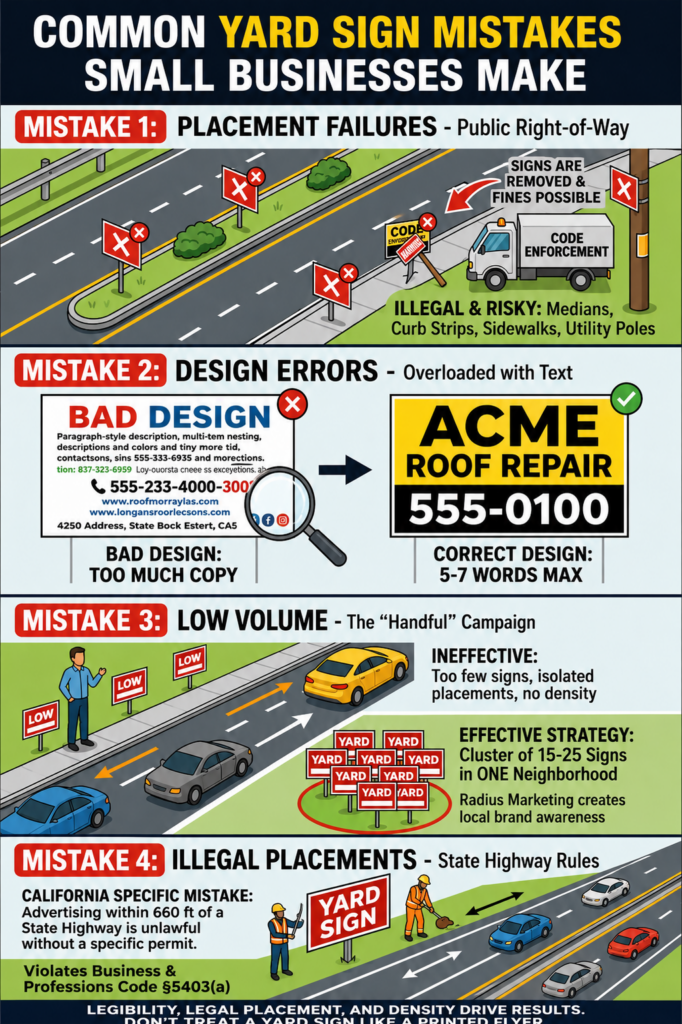
Common Yard Sign Mistakes That Kill Results
Most unsuccessful yard sign campaigns fail because of placement, design, or density—not because yard signs don’t work. The infographic below summarizes the most common mistakes small businesses make and how to avoid them.
How to Know If Your Yard Signs Are Working
Track yard sign performance with a dedicated phone number tied only to sign campaigns, UTM-tagged QR codes linked to a campaign landing page, and a simple “how did you find us” question asked of every new caller — no specialist software required.
- Unique trackable phone number on yard signs only. Any call to that number came from a sign.
- QR code linking to a campaign landing page with UTM parameters. Google’s Campaign URL Builder (Google Campaign URL Builder) generates tagged links that appear in Google Analytics by source and campaign.
- Ask every new caller how they found you. A manual weekly tally is sufficient for small campaigns.
- Google Business Profile insights track calls, direction requests, and website clicks — useful for detecting lift in neighborhoods where you’ve run a sign push (Google Business Profile).
Set realistic expectations. Yard signs are a brand-building channel. Most campaigns show measurable results over 30 to 90 days, not overnight. If results aren’t materializing after a full campaign cycle, check placement legality, sign density, and design readability — those three factors account for most campaign failures.
When to Order and How Fast You Can Get Your Signs
For most planned campaigns, order two to three weeks before signs need to be in the ground — not because print time is long, but because the real bottlenecks are design approval, hardware sourcing, property permission from owners, and local permit requirements. In California, some placements require encroachment permits or city sign permits that take days or weeks. Don’t print first and ask legal questions later.
If you need signs urgently, local pickup is the fastest option. For a planned campaign, it’s often faster and cheaper to design online and order online through a dedicated sign printer — lower per-sign pricing at volume, more consistent output, and no in-store wait. A full speed-and-price breakdown is in the section below.
Order before your busy season. By the time demand peaks, your signs should already be placed.
For a more technical breakdown of materials, design specifications, California compliance details, and industry-specific strategies, continue below.
Yard Signs for Business Near Me — Why Online Often Wins
Online sign printers typically win on price, format variety, and bulk-order consistency — local print shops win on turnaround speed. For planned campaigns of 10 or more signs, online ordering almost always costs less. The “near me” search intent often reflects urgency; the right question is whether you’re buying an emergency batch or building a campaign.
When Local Pickup Is the Right Call
Local printers and office-print chains excel when the requirement is speed. Same-day or next-business-day pickup is a realistic option for businesses that need signs before a job starts tomorrow or an event this weekend. In-person proofing — seeing the physical sign before committing to a larger run — also has value when color accuracy or exact sizing is critical.
The tradeoffs: local print locations often carry fewer size options, may price small runs higher, and may not offer the full substrate range (corrugated plastic, PVC, aluminum composite) that an online specialty printer provides.
When Online Ordering Is the Better Choice
Online ordering tends to win when the job is planned rather than urgent. The ability to design online, select from multiple sizes (commonly 12″ × 18″ through 36″ × 48″ and beyond), and order online in bulk — all without leaving a desk — makes this the practical choice for planned campaigns.
Additional advantages include lower per-unit pricing at volume, standardized repeat orders for ongoing campaigns, and direct-to-location shipping. For businesses running structured campaigns across a defined service area, consistent specs across every batch produce a more uniform branded presence than mixing print runs from multiple local sources.
Side-by-Side Comparison
| Factor | Local Pickup | Online Printer |
|---|---|---|
| Turnaround | Same day to next day | Typically 2–5 business days |
| Size options | Often limited | Broader range |
| Per-unit cost (small run) | Often higher | Often lower |
| Per-unit cost (bulk, 25+) | Comparable or higher | Lower at volume |
| In-person proofing | Yes | Digital proof files only |
| Consistency across large runs | Variable | More standardized |
| Geographic access | Local only | Ships anywhere |
“Near me” is not automatically better. Local wins when speed or in-person assistance is the priority. Online wins when you’re building a repeatable campaign system, need unusual sizes, or ordering in quantity.
Custom Yard Signs for Business vs. DIY — What Actually Costs Less?
DIY sign-making looks inexpensive at first glance. The true cost calculation changes when you account for materials, time, equipment, and what an unprofessional-looking sign costs your brand impression.
The Real Cost of DIY
A blank corrugated plastic board in the 24″ range costs roughly $10–$15 in retail hardware formats. Hand-lettering requires paint markers, stencils, or a vinyl cutter — plus the time to use them. A vinyl cutter capable of producing clean, consistent sign lettering typically starts at $300 or more at the consumer level and requires a meaningful learning curve. At $15 per blank board plus materials plus 30–45 minutes of skilled labor per sign, a DIY run of 25 signs can cost more in time alone than a professionally printed equivalent.
Additional hidden costs: inconsistent lettering quality across a sign set, non-UV-resistant inks that may fade within weeks under California sun, and a brand impression that signals “side hustle” rather than “established business.” A sign with uneven lettering doesn’t just fail to convert — it can actively undermine credibility.
When Custom Printing Wins
For any public-facing business campaign of 10 or more signs, professional printing typically delivers lower true cost once labor is included in the DIY calculation. Custom corrugated signs from a dedicated print shop include full-color output, UV-resistant inks, a consistent template replicated across every unit, and H-stake compatibility out of the box. At quantity, per-sign pricing drops to a range competitive with — or below — the raw material cost of quality DIY blanks.
The design file is a one-time expense that amortizes across every reorder. Once the file exists, repeating or expanding the order is fast and produces identical results.
When DIY Defensibly Makes Sense
DIY is justifiable for a one-off directional sign for a private event, a temporary placeholder while waiting for a professional order, or an internal-use sign where appearance is irrelevant. For any sign a customer or prospect will see — particularly in a competitive market like Orange County — the brand-impression risk of DIY typically outweighs the marginal cost savings. Most professionally printed signs can be designed online and ordered in minutes, making the gap between DIY effort and custom quality smaller than most business owners expect.
Yard Sign Advertising vs. Other Local Marketing Methods
Yard signs cost less per impression than most local advertising and stay in place around the clock — but they’re weak at capturing buyers who are already searching. Understanding that gap is what determines how to pair them with digital channels.
Full Channel Comparison
| Method | Cost Structure | Geographic Targeting | Attribution | Persistent? |
|---|---|---|---|---|
| Yard signs | One-time print cost | Neighborhood-level | Low–medium | Yes (while posted) |
| Google Business Profile | Free | Intent + proximity | High | Yes |
| Google Local Services Ads | Pay-per-lead | High intent | High | Yes (while active) |
| USPS Every Door Direct Mail | Per-piece + design | Route-based | Low | No (transient) |
| Door hangers | Print + distribution labor | Street-level | Low | No |
| Nextdoor Ads | Monthly budget | Hyper-local | Medium | No |
| Vehicle/magnetic signs | One-time | Route-based | Low | While moving |
Where Yard Signs Outperform
Yard signs outperform most digital channels on cost per impression for neighborhood-level brand awareness. A single print order produces weeks of impressions from the same local audience — homeowners, renters, and commuters passing a sign repeatedly. For a business whose ideal customer lives within two miles of a current job, that repeated local exposure is difficult to replicate with paid digital at equivalent cost.
USPS Every Door Direct Mail offers comparable neighborhood targeting at roughly $0.25 per piece in postage — but direct mail is transient. Seen once, then discarded. A sign stays in position for weeks and accumulates impressions with each pass.
Where Yard Signs Trail
Yard signs are weak for capturing high-intent, in-market search traffic. A homeowner actively searching “HVAC repair Irvine” with a broken system is best reached through Google Local Services Ads or a well-optimized Google Business Profile — not a sign they passed on the way to work. Google notes that local search ranking is primarily driven by relevance, distance, and prominence (Google Business Profile Help).
The Practical Local Stack
Yard signs paired with a strong Google Business Profile is the minimum effective combination for most local service businesses. Signs create neighborhood awareness and job-site proof; Google captures the search that follows. Adding vehicle signage for mobile crews extends physical brand coverage along every service route at no additional recurring cost.
The Best Outdoor Advertising Signs for Local Businesses
The best outdoor sign system for a local business typically combines two or three formats: yard signs for neighborhood presence, vehicle signage for mobile coverage, and window or storefront signs for conversion at the point of sale. No single format does all three jobs well.
By Business Type and Use Case
The optimal outdoor sign format varies by whether a business travels to customer locations, operates from a fixed storefront, or runs time-limited events.
Service-area businesses (contractors, landscapers, HVAC, plumbers, painters): The most effective outdoor stack typically combines corrugated yard signs at customer properties with vehicle branding on service trucks and vans. Yard signs create stationary neighborhood presence; vehicle signage extends visibility along every route the crew drives.
Storefronts (retail, food, salons, service businesses with a fixed location): Window graphics, A-frame or PVC entry signs, and curb-facing yard signs address different conversion points. Window graphics convert walk-by traffic. A-frames capture sidewalk attention at the entry. Yard signs perform best at driveways and parking-lot entries where a vehicle-borne customer is making the final turn decision.
Events, markets, pop-ups, and grand openings: Corrugated yard signs are well-suited for temporary directional use — lightweight, stakeable, and disposable after the event. For large-format awareness at the event itself (stage backdrops, entrance markers, high-visibility presence), vinyl banners are the stronger format.
Long-term roadside identity: Aluminum composite or rigid sign panels are the appropriate material when a sign needs to hold up through multiple California seasons without fading, warping, or losing structural integrity. Per-unit cost is higher; multi-year lifespan makes the economics favorable compared to repeated corrugated replacements.
The most effective local sign systems use two or three complementary formats rather than relying on a single type for every placement context.
Need More Than Yard Signs?
Explore banners, window graphics, magnetic signs, aluminum panels, PVC signs, decals, and other outdoor advertising products to complete your local marketing system.
Yard Signs for Specific Industries — Strategies That Work
For home-services businesses, job-site radius marketing typically produces the strongest return per sign. For real estate, the full directional network — listing, open-house, and just-sold signs — outperforms any single placement type. Each industry below requires a different sign strategy.
Contractors and Home Services
Radius marketing typically delivers the highest ROI for home-services businesses. Place signs within three to five blocks of each active customer property — not just on the property itself, but at nearby intersections on private property and in willing neighbor yards. The implicit message is powerful: “we are already working in this neighborhood.” Roofers, painters, landscapers, pressure washers, and HVAC companies in Irvine and Orange County operate in service areas where this approach maps directly to customer geography.
One tactical extension: where a job requires a visible permit board posted at the property line, place your sign directly alongside it. Permit boards signal active permitted work in progress — any neighbor who looks is a pre-qualified prospect.
Real Estate Agents
A listing sign is the beginning, not the complete strategy. Real estate signs tied to active listings are among the most proven forms of localized yard sign advertising — the approach has worked across many states for decades and remains the standard for real estate listings of all price points. The full approach for agents includes the listing sign on the property, open-house directionals at legal private-property turns on surrounding roads, and a “Just Sold” or “Just Listed” notice left up briefly post-transaction. This builds a visible local track record across residential areas — distinct from a single listing sign. All directional signs should be removed within 24 hours of the event or transaction closing.
Restaurants and Food Businesses
Yard sign advertising for food businesses works best as a time-sensitive trigger: grand opening blitz in a one-mile radius for the first two to four weeks, seasonal special, limited-time offer, or hiring announcement. Research from OAAA’s category analysis found that food and beverage advertising performs well when it highlights new products or savings — specificity drives action (OAAA).
Political Campaigns
California allows political yard signs on private property starting 90 days before a scheduled election, with full removal required within 10 days afterward (Caltrans Outdoor Advertising). Under California Civil Code §4710, property owners cannot be prohibited by an HOA from displaying political signs on their own property. Near state highways, temporary political signs within 660 feet of the right-of-way are limited to 32 square feet and require a Statement of Responsibility filed with Caltrans. Timing, size limits, and local removal deadlines vary by city — verify before ordering.
Event Promoters
The directional sign network for an event starts with the venue coordinator — confirm which adjacent private properties allow signage and whether the venue has any pre-approved placements already negotiated. Place signs at every route decision point: main road turn-ins, parking lot entries, overflow parking indicators, and check-in routing. For events in business districts or on private venue grounds, written permission from each property owner is required before staking. A sign pulled by code enforcement on event day eliminates the one moment it was built for — get permission documented in advance.
Corrugated Plastic vs. PVC vs. Sign Panels — Full Comparison
Material selection determines lifespan, print quality, mounting options, and cost per campaign cycle. The right choice depends on use case, not on which material is abstractly “better.”
Technical Specifications
| Specification | Corrugated Plastic | PVC | Aluminum Sign Panel |
|---|---|---|---|
| Standard gauge | 4 mm | 3–6 mm | 0.040″–0.080″ composite |
| Typical outdoor lifespan | Several months to ~2 years | Up to ~12 months (outdoor) | 5+ years |
| Common mounting methods | H-stake, wire stake, spider stake | Frame, A-frame, screws | Hardware, U-channel posts, screws |
| Best viewing distance | Medium — roadside, customer property | Close — storefront, entryway | Medium to far — roadside, fence |
| Print quality | High | Very high | Very high |
| Weather resistance | Good | Good | Excellent |
| Weight | Light | Medium | Medium–heavy |
| Relative cost per unit | $ | $$ | $$$ |
| Optimal use case | Volume campaigns, staking | Storefront, A-frame display | Long-term roadside, fence mount |
How to Choose
Corrugated plastic signs are the right starting point for most yard sign campaigns — especially any campaign requiring ten or more staked placements in lawns, customer properties, or parking areas. Lower per-unit cost enables the density that makes a local campaign effective. For long term outdoor use, specify UV-resistant inks and consider a glossy coating to protect color and extend lifespan. One real-world caveat: even with a coating, corrugated lifespan varies by UV exposure and temperature — a sign in prolonged California summer sun may need replacement sooner than spec estimates suggest.
PVC bridges corrugated and aluminum in appearance and durability. Better at close range, rigid enough for A-frames and wall-mount applications, but not practical for large-scale staking. It suits businesses needing a few polished display signs at a storefront or entry point rather than a broad neighborhood campaign.
Aluminum sign panels are the right choice when permanence matters more than volume — for businesses wanting one or two durable roadside signs representing the brand across multiple seasons. The per-unit cost premium is recovered over a multi-year lifespan that far exceeds corrugated replacement cycles.
Turn Your Plan Into a Campaign
You’ve got the strategy. Now get the signs. Order online, upload your design, and have professional yard signs ready for your next promotion, job site, or event.
Frequently Asked Questions
Where can I legally put yard signs for my business?
In California, yard signs may be placed on private property with the property owner’s explicit consent — this includes your own business location, active customer properties, and any private lot where the owner has agreed in writing or by text message.
Public right-of-way placements — medians, curb strips, sidewalks, utility poles, and road signs — are prohibited under California Business and Professions Code §5403(a), which Caltrans enforces along state highways (Caltrans Maintenance Manual). At the city level, Los Angeles, Claremont, and Brea all specifically prohibit signs in public right-of-way without a permit. OC Public Works has a formal sign-posting policy for unincorporated Orange County (OC Public Works).
The safest rule: if you’re not certain a location is private property and you don’t have written permission, don’t stake there. Verify Irvine-specific rules with the City of Irvine Planning and Building Department before launching a campaign.
How effective are yard signs for advertising a small business?
Yard signs tend to be most effective for local service businesses — contractors, landscapers, HVAC companies, painters — where the customer base is the neighborhood around each active job. Effectiveness depends on density and placement quality, not on sign count alone.
Broader out-of-home research supports the underlying principle — OOH campaigns show measurable in-person and digital lift when concentrated in defined local areas, as detailed in the article’s opening section. Yard-sign-specific studies are limited, but the mechanism is well-documented: repeated exposure to the same brand in a defined geography drives recognition, and recognition drives calls. Businesses that report poor results from yard signs typically used too few, placed them in low-traffic locations, or had designs that weren’t readable at traffic speed. Adding a dedicated trackable phone number to sign campaigns turns anecdotal results into measurable data.
What should I put on a business yard sign?
Limit the sign to five elements or fewer: your business name or logo, one primary service in two to four words (“Roof Repairs,” “House Painting,” “Free Estimates”), a phone number, an optional short URL, and a brief call to action if space genuinely allows.
The most common mistake is overloading the sign. WSDOT’s traffic operations research indicates drivers typically comprehend about three words per second after an initial perception delay (WSDOT, 2025) — anything beyond the core message may not register at normal road speeds. Use at least 3-inch capital letter height for the primary text line, choose high-contrast color combinations, and avoid decorative fonts that sacrifice legibility for style. The test: can a driver who has never heard of your business read your name and know how to reach you in three seconds? If yes, the sign works.
How many yard signs do I need to run a successful business advertising campaign?
There’s no published universal benchmark — out-of-home advertising performance is measured by impressions, reach, and frequency rather than raw unit count. What matters is whether the same potential customers encounter your brand repeatedly in a defined area.
A practical starting point: count how many legal private-property placements exist within your target radius — customer properties, willing neighbor yards, corner-business frontages, your own storefront. That number sets a realistic ceiling. From there, aim for enough signs that a typical resident driving the main local routes encounters your brand two or three times in a standard week. For most service-area businesses, that works out to somewhere between 15 and 25 concentrated signs — though the right number depends on service area size, legal placement opportunities, and campaign budget. Some businesses rotate a set of 25 to 30 signs across 10 to 12 locations, shifting placements every two to three weeks to reach fresh audiences as the campaign matures.
What is the standard size for business yard signs, and which size is best for roadside advertising?
The 18″ × 24″ format is the most widely used standard across most business sign applications — it fits most wire H-stakes, suits a wide range of residential and light-commercial street speeds, and provides sufficient surface area for a clean, readable layout.
The U.S. Sign Council’s legibility guidelines indicate approximately 30 feet of readable distance per inch of capital letter height for perpendicular roadside signs (USSC), which means an 18″ × 24″ sign with 3″ headline letters is readable from roughly 90 feet — adequate for roads up to about 35–45 mph. For faster arterial roads, or signs placed farther from the curb, 24″ × 36″ is typically the better choice. If traffic speed is high enough that even a 24″ × 36″ format feels marginal for readability, a larger format — vinyl banner or permanent on-premise panel — is likely the right tool for that specific location.
Can I put yard signs for my business on public property, at the side of the road, or at intersections in California?
Generally no, without a permit — and in many California jurisdictions, not at all regardless of permit status.
California Business and Professions Code §5403(a) prohibits advertising displays within state highway right-of-way, and Caltrans is authorized to remove them and bill responsible parties for removal costs (Caltrans Maintenance Manual). At the city level, local ordinances in Los Angeles, Claremont, and Brea specifically prohibit temporary signs in public right-of-way, medians, sidewalks, and on poles or trees. Sacramento has a narrow exception allowing certain temporary signs in the planting strip between curb and sidewalk — which illustrates the point: rules vary enough by city that you cannot safely assume any roadside strip is legal without checking the municipal code.
Similar public-property restrictions exist in many states, not just California — but the specifics vary significantly by jurisdiction. Verifying the applicable rules before ordering is the only reliable way to avoid fines and sign removal.
For Irvine and unincorporated Orange County, treat all public right-of-way as off-limits by default and work exclusively with private-property placements and documented owner consent.
What are the most common yard sign mistakes small businesses make that kill results?
The most frequent errors, in approximate order of impact: too much copy in the primary message area (more than seven words), letter height too small for the traffic speed of the placement location, illegal placements in public right-of-way that result in removal before the campaign runs its course, poor color contrast between text and background, all-caps text that requires approximately 15% more letter height than mixed-case to achieve equivalent legibility (USSC), and relying on a single isolated sign rather than a cluster in a defined area.
The underlying pattern across most failures is the same: treating a yard sign like a printed flyer rather than a three-second driver-communication tool. Legibility, legal placement, and density account for most of the gap between campaigns that generate calls and campaigns that don’t.
How do I design custom yard signs for my local contracting or home services business?
Start with proof, not polish. Your brand name and your primary service — “Landscaping,” “Roof Repair,” “Pressure Washing” — are the two pieces of information that matter most to a neighbor who just watched your crew finish a job next door.
Keep the layout to: business name (or logo if it’s legible at sign scale), one service line in large bold type, and a phone number. Avoid listing multiple services, avoid including a web address on a high-speed roadside placement, and avoid fonts that look sharp on a screen but fail at 3-inch physical height. If you include images, keep them simple — complex photographs lose definition at corrugated print resolution and rarely help readability at distance. High-contrast colors — black on yellow, white on navy, red on white — consistently outperform muted brand palettes under field conditions. USSC research confirms that contrast materially affects real-world legibility distance (USSC).
An eye-catching color combination and clean shape outperform visual complexity at every traffic speed. A glossy coating adds durability and vibrancy, particularly for long term outdoor use in Southern California sun. Most professional sign printers provide templates where you can build and preview your layout online before ordering.
Are local print shops cheaper or faster than ordering yard signs online?
Local is often faster for small urgent orders — same-day or next-business-day pickup is available through some local printers depending on quantity and complexity. It’s not automatically cheaper, particularly for orders of 10 or more signs, where online print shops typically offer lower per-unit pricing, broader size options, and bulk-order discounts unavailable at retail locations.
For a planned campaign of 25 or more signs with consistent specifications, the ability to design online and order online makes the process faster and cheaper than visiting a local shop. The exception is when in-person proofing before a large run is essential, or when signs are needed within hours. For most businesses building a repeatable yard sign campaign rather than responding to an emergency, online ordering and direct shipping is the more practical and often more cost-effective system.
What is the difference between yard sign advertising and other outdoor advertising signs for small businesses?
Yard signs are the low-cost, hyperlocal, stake-mounted option — suited for temporary campaigns, job-site proof, neighborhood density, and event direction. They differ from other outdoor formats in several key ways.
Window graphics and A-frame signs target people already near a storefront, converting walk-by and entry traffic rather than reaching neighborhood drivers. Vehicle or magnetic signs move with service crews and multiply visibility along every route without additional placement logistics. Vinyl banners provide large-format, high-visibility presence for grand openings and events where maximum immediate attention is the priority. Aluminum sign panels or permanent on-premise signs serve long-term identity at a fixed location. Note: Printastic produces corrugated plastic yard signs only.
Yard signs occupy the middle of that ecosystem: affordable enough to deploy at volume, flexible enough for multiple temporary placements, and most effective for any business whose customers are neighbors within a few miles of where work happens. The strongest local advertising systems use two or three of these formats in combination rather than relying on any single type.
Disclaimer
This information is provided for general awareness. Sign regulations and placement rules vary by city, county, and proximity to state and federal highways. Verify current requirements with your local planning department, county code enforcement office, and Caltrans before placing any sign in or near public right-of-way. If signs are removed by code enforcement, contact your local city planning department to recover them and clarify placement rules before reordering
Author & Content Transparency
This guide was created by the Printastic team based on our experience producing custom signs and print products for businesses, contractors, event organizers, and local advertisers. The recommendations in this article reflect practical considerations we encounter regularly, including sign visibility, material durability, design readability, and real-world placement considerations.
To create this content, we combined firsthand industry knowledge with research from publicly available sources, including government agencies, industry organizations, and sign-legibility studies where applicable. All information is reviewed and edited by team members familiar with commercial printing, signage production, and customer use cases before publication.
We may use AI-assisted tools to help organize information, improve readability, or streamline content development. However, AI is used as a drafting aid only. Final content is reviewed, fact-checked, edited, and approved by humans prior to publication.
Our goal is to create helpful resources that answer common customer questions and provide practical guidance based on real-world experience. Content is published to help readers make informed decisions—not simply to improve search rankings.
If regulations, product specifications, or industry best practices change, we periodically review and update our content to maintain accuracy and relevance.