
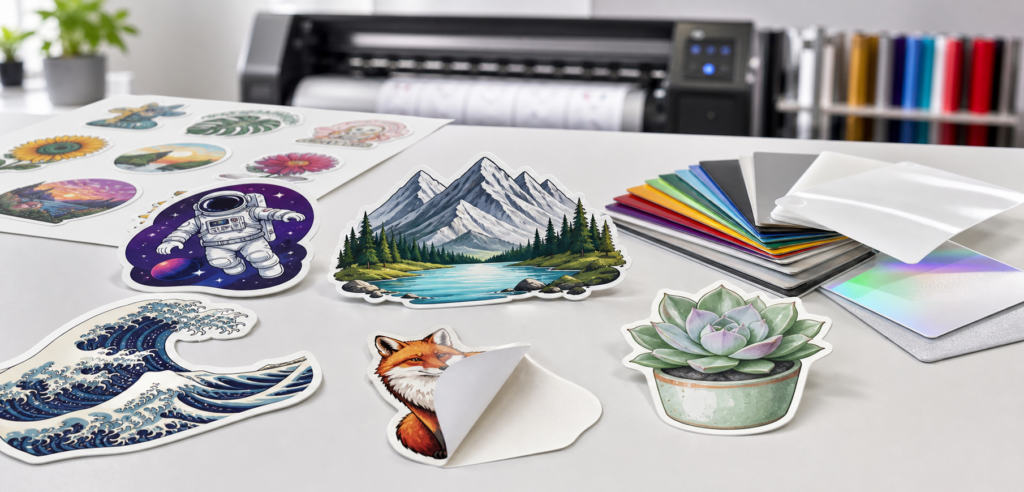
Die-cut stickers are custom adhesive graphics cut through the print layer and the backing liner along a custom contour that follows the shape of the artwork, rather than being limited to a standard square, rectangle, or circle. Among custom stickers, this is the option built for a unique shape. The result depends on five things: cut style, material, adhesive, finish, and how the pieces arrive, as loose singles or grouped on a sheet. Get those right and the stickers hold up once they’re on a laptop, a window, or a bumper.
What Are Die-Cut Stickers?
A die-cut sticker is cut all the way through its print material and backing paper, following a custom contour around the design instead of a plain square or circle. The name comes from metal dies once used for this cut, though most shops today use a digital plotter reading a vector path (a mathematically defined line, not a raster image) to drive the blade.
Depending on the printer and its production tolerances, a small safety border may be left around the artwork rather than a perfectly borderless edge, which “Materials and Finishes” and “Custom Die-Cut vs. Vinyl” below cover in more detail.
“Die-cut sticker” describes a cut, not a material or a size. A logo sticker, a car decal, and a small product label icon can all be die-cut, even though they look nothing alike. What they share is a perimeter that traces the artwork’s contour, so the sticker becomes the shape of your design once peeled off the sheet.
Die-Cut vs. Kiss-Cut Stickers: What’s the Difference?
A die-cut sticker is cut through both the sticker material and the backing liner, while a kiss-cut sticker is cut only through the top layer, leaving the backing intact. That single difference changes how the sticker looks, peels, and what it’s best suited for: a die-cut piece separates fully into a loose, individually cut sticker, while a kiss-cut sticker stays attached to a larger backing sheet until you peel it away, which protects thin points in the design and makes it the standard method for multi-design sticker sheets, covered in more depth in the Technical Breakdown below.
What Are Die-Cut Stickers Made Of? Materials and Finishes
Most commercial die-cut stickers are printed on vinyl, a durable plastic film that holds color and resists moisture better than paper, which is why paper stock is generally reserved for short-term indoor use. Vinyl itself splits into a few layers of choice, covered with a comparison table in “Budget-Friendly” below: the construction (calendered or cast), the finish (gloss, matte, or clear), and whether a protective laminate is added.
Printastic’s confirmed die-cut stock is 3M brand gloss calendered vinyl. Clear vinyl and matte finishes are common elsewhere in the industry, but aren’t listed as current options on Printastic’s die-cut sticker configurator, so don’t assume that finish is available without checking directly. Printastic’s own adhesive and vinyl guide compares its material options side by side.
Are Die-Cut Stickers Waterproof and Durable?
Well-made vinyl stickers are typically waterproof, but the cut style has nothing to do with it. Waterproofing comes from the material, the ink, and any laminate applied over the top, not from how the edges were cut.
Vinyl is naturally water-resistant in a way paper isn’t, and a laminate adds further protection against scratches, chemicals, and fading from sunlight. That combination is why vinyl stickers commonly end up on water bottles and car bumpers exposed to daily weather. Still, “waterproof” shouldn’t be read as “indestructible.” Durability depends on the material and finish being rated for the job, so check that before committing a design to a demanding surface. For rough, curved, or low-grip surfaces, high-tack stickers use a stronger adhesive built for exactly that.
Popular Uses for Die-Cut Stickers
They work best on designs where the outline itself is part of the branding, like logos, mascots, and lettering. Because the shape reads instantly, custom shaped stickers suit laptop and bottle branding, packaging, and giveaways. Small business owners use them for packaging and pop-up events, sports teams use them for fan merchandise, and some people design them to sell on their own. Die-cut is just one option in Printastic’s sticker lineup, worth confirming before you commit to a shape.
Die-cut car stickers cover a similar range, from small club decals to larger window and bumper graphics. Since many sticker adhesives are permanent, think ahead about how long you want a car sticker to stay put.
How to Prepare Your Artwork for a Die-Cut Sticker
A die-cut order needs a cutline, a vector path that tells the cutting equipment exactly where to trim, in addition to the printed design. Without it, custom shape cutting isn’t possible, no matter how sharp the image looks. Uploading your own vector file is what gives you control over the exact shape, rather than leaving it to a shop’s default settings.
You’ll also need bleed around that cutline, extra printed background that extends past the intended edge. Bleed exists because cutting hardware has a small margin of error, so if the blade drifts, it cuts through printed color instead of exposing blank vinyl. Vector formats (AI, EPS, or PDF) handle cutlines most cleanly. Raster images work too, as long as they’re supplied at actual size and 300 DPI (dots per inch, a measure of print sharpness), to avoid a blurry edge.
Don’t have artwork yet?
Build your sticker design right in the browser.
- Start from a blank canvas or a template
- Upload and adjust your own artwork
- Export a print-ready file
Preparing your own file instead? Printastic’s die-cut file setup guide covers cut lines and bleed in more depth than fits here.
Choosing the Right Size and Shape
The right sticker size depends on where it’s going and how close someone will stand to read it, not on how the design looks zoomed in on a monitor. Available dimensions vary by printer, but most commercial shops let you customize and set an exact size somewhere between 2 inches and roughly a foot across, covering everything from a packaging accent to a large window decal. Printastic’s own die-cut range, covered later in “What to Expect,” runs 2×2 to 12×12 inches.
Shape matters too. A design with thin points or sharp inward corners is more fragile once cut loose from its backing. Rounding off sharp corners usually produces a sturdier sticker without changing how the design reads.
How Much Do Die-Cut Stickers Cost?
Die-cut sticker pricing depends mainly on size, material, lamination, and quantity. Larger stickers use more vinyl and ink, premium materials cost more than standard gloss vinyl, and per-sticker cost drops as quantity goes up, since setup costs spread across more pieces.
That last point is usually the biggest lever a buyer has. A small order absorbs the full cost of file setup and machine calibration on a handful of pieces, while a larger order spreads that cost over hundreds of stickers. Testing a design at a small quantity before a bulk run is a reasonable way to catch problems before paying for a large batch.
How to Apply a Die-Cut Sticker
A die-cut sticker adheres best on a surface that’s clean, dry, and free of dust, oil, or wax, so wipe the area down and let it dry first. Skipping this step is the most common reason a sticker lifts at the edges within days.
Line up one edge first, rather than dropping the whole piece down at once, so you can adjust before the adhesive grabs. Then press outward from that edge with a flat, firm tool, like a card or squeegee, to push trapped air toward the open sides. Many adhesives are permanent once applied, so test on a small hidden area first and treat placement as final once you commit.
What to Expect When You Order Die-Cut Stickers from Printastic
Ordering from Printastic starts with uploading artwork, choosing a size between 2×2 and 12×12 inches, and picking whether to add a laminate. Every file then goes through a manual check before production, since a missing cutline or bleed means the order can’t be cut correctly.
See what your order actually costs
Enter your size, material, and quantity for a real number.
- No account needed to check pricing
- Configure size, material, and finish together
- Order directly once you’re ready
If you’re local to Irvine, California, you also have the option to pick your order up in person instead of waiting on shipping. Production time and delivery time are separate clocks, so check a shipping estimate for your area before counting on a delivery date. For anything specific to your order that this guide doesn’t cover, Printastic’s contact page is the fastest way to reach a real person.
For a more technical breakdown, continue below.
Custom Die-Cut Stickers vs. Custom Die-Cut Vinyl Stickers: Which Should You Choose?
These aren’t really competing options, because one term describes a cut and the other describes a material. Any die-cut sticker can be made from vinyl, paper, or another substrate, so “die-cut vinyl sticker” is simply a more specific version of “die-cut sticker.”
In practice, the distinction mostly disappears once you’re comparing finished products, because vinyl has become the default face material for most commercial die-cut stickers. Printastic’s own die-cut sticker line, for example, uses 3M brand gloss calendered vinyl (a vinyl film pressed flat between heated rollers during manufacturing) as its standard stock, described as water- and UV-proof for indoor and outdoor use (Printastic). So when a shop’s default “die-cut sticker” product is already vinyl, asking for a “die-cut vinyl sticker” typically gets you the same item.
One detail worth knowing ahead of time: Printastic’s die-cut stickers ship with a thin white border, about 1/16″ to 1/8″ wide, left around the design by default. It’s there to compensate for small variances in the cutting process, not a mistake, but it means the sticker isn’t perfectly borderless the way “die-cut” might suggest.
The distinction between “die-cut” and “die-cut vinyl” becomes meaningful again only when a shop also offers a non-vinyl option, like paper labels or a specialty clear film, where naming the material actually changes what you get.
Adhesive Types: Permanent, Removable, and High-Tack
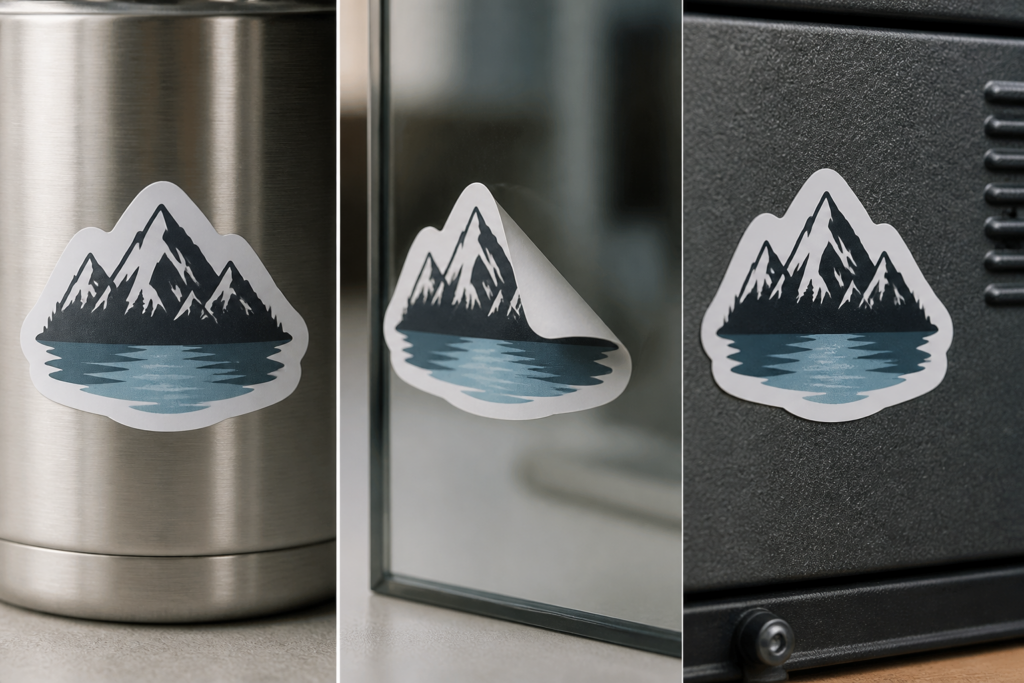
The cut style of a sticker has no bearing on how its adhesive behaves. Die-cutting only determines the shape and how the backing separates. Whether a sticker can be removed later, how well it grips a rough surface, and how long the bond holds are all properties of the adhesive formulation, not the cut.
Printastic’s standard die-cut stock uses a permanent, non-removable adhesive: once it bonds, taking it off risks damaging the sticker, the surface, or both. Its laminated line, by contrast, uses an adhesive rated as removable for up to two years under normal conditions, which suits temporary branding or anything you might want to change later. High-tack stickers sit at the other end, formulated with extra initial grip specifically for low-energy, hard-to-stick surfaces like certain plastics, moldings, and powder-coated finishes, and Printastic recommends treating that adhesive as permanent since it’s not designed to come off cleanly.
For smooth surfaces like glass, laptop shells, and sealed packaging, a standard permanent adhesive usually holds without issue. For textured plastic, matte-finish coolers, or powder-coated equipment, a high-tack formulation is the safer bet. For anything you expect to reposition or eventually remove, like a seasonal promotion or a rental property, ask specifically about a removable option rather than assuming any given sticker qualifies.
How Long Do Die-Cut Stickers Actually Last?
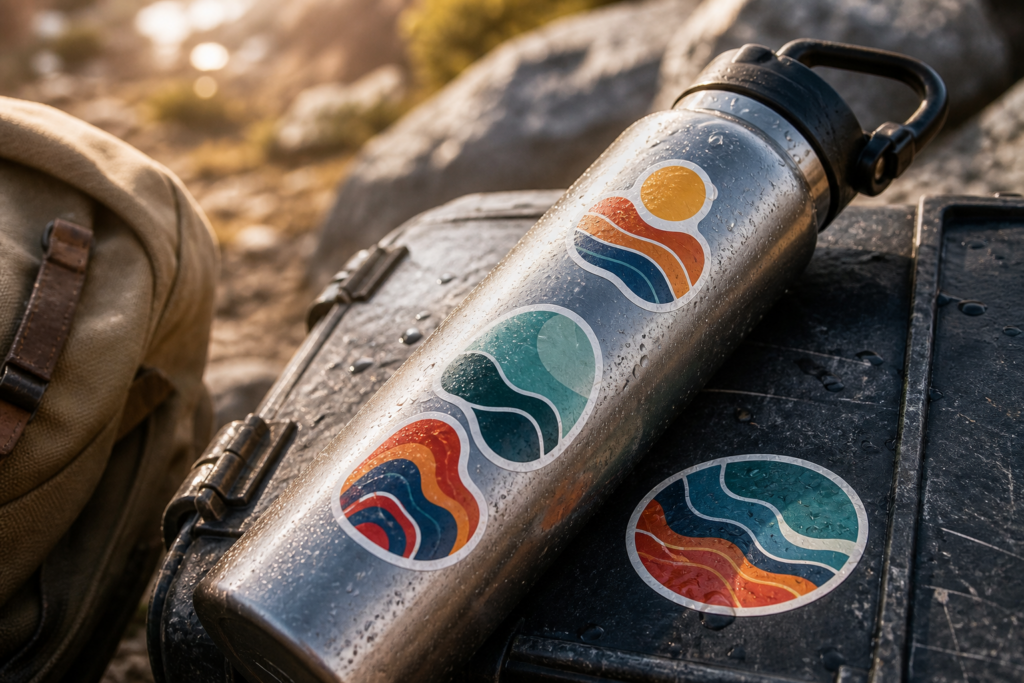
Lifespan isn’t one number, since it depends on the material, the laminate, and how and where the sticker is used. Indoor use, out of direct sunlight, extends any sticker’s working life well past its outdoor rating. Outdoors, UV exposure, climate, surface prep, and how often the sticker gets cleaned or abraded all shorten or extend that number in practice.
Where a shop publishes an actual rating, that’s more useful than a general estimate. Printastic’s standard die-cut stock is rated for indoor and moderate outdoor use as-is, extending to up to five years outdoor once a clear laminate is added. Its high-tack line carries a similar five-year outdoor rating on flat, smooth surfaces in indirect sunlight, stretching to up to eight years with an optional laminate.
If a shop hasn’t published a rating for the specific product you’re looking at, treat any lifespan number as a rough estimate rather than a guarantee, since none of these vinyl products carry a manufacturer warranty against fading or lifting.
Die-Cut Sticker Sheets vs. Individual Die-Cut Stickers
A die-cut sticker sheet holds several kiss-cut designs on one shared backing, while individually cut stickers are cut all the way through and separate into standalone pieces. The choice comes down to whether you want one design per piece or several designs sharing a page.
Sheets make sense for a collection of designs, like a set of icons, a branded backing with multiple stickers, or artwork with delicate points that benefit from a surrounding backing for protection during shipping and handling. Printastic’s sticker sheet product, for instance, arrives as an 8.5 x 11-inch sheet of vinyl with the individual designs kiss-cut so they peel away cleanly, leaving the backing sheet intact (Printastic).
Die-cut sticker singles, by contrast, work better when each sticker needs to function on its own, such as a one-at-a-time giveaway or a single logo applied to a product. Neither format is a stronger choice on its own. It depends on whether the end use calls for one sticker or several at once.
Die-Cut Sticker Printing: What Affects Turnaround and Print Quality
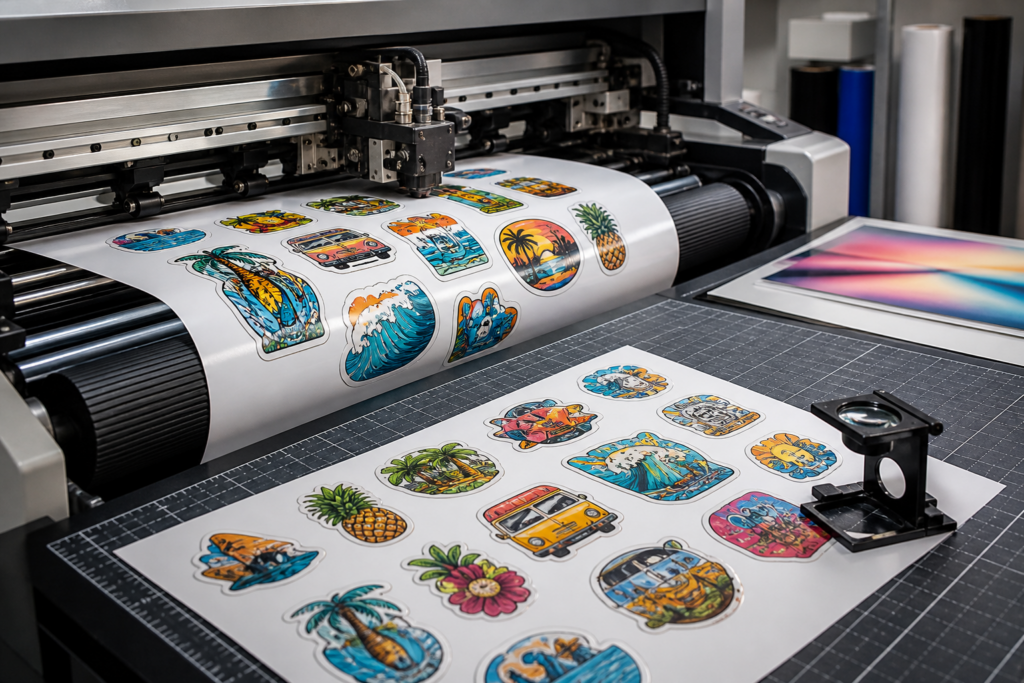
Print quality on a die-cut sticker comes down to source artwork resolution, ink and printer capability, and how precisely the cutting equipment lines up with the printed image. Turnaround depends more on file readiness and order volume than on the printing step itself.
On the print side, commercial shops that print die-cut stickers commonly use eco-solvent printers with wider color sets than a standard four-color desktop printer, which produces full color printing with vibrant colors and helps reproduce gradients and fine detail without visible banding. Printastic’s own equipment, for example, uses an eight-color ink set at 1440 DPI print resolution, though that print resolution is a separate number from the 300 DPI resolution requested for your uploaded artwork. One doesn’t compensate for the other.
On the cutting side, registration, the process of aligning the cutting blade with the already-printed image, matters most on intricate or oversized designs, where even a small misalignment becomes visible along the cut edge. Contour cutting depends on that alignment holding steady between the printed graphic and the cut path.
A fast turnaround, separately, is shaped mainly by whether a submitted file passes inspection on the first try. Printastic manually reviews every upload before production begins, and a file that’s missing bleed or a cutline gets sent back rather than run, which means getting the file specs right the first time is often the biggest lever a customer has over how fast an order actually ships.
Will My Sticker’s Colors Match What I See on Screen?
Not exactly, and that’s normal rather than a sign of a defect. Screens display color as RGB light, while printers build color from layered ink, so very bright or saturated on-screen colors don’t always have an exact ink equivalent. Monitor calibration adds another variable, since two uncalibrated screens can show the same file differently. DPI and color accuracy are also separate issues: a high-resolution file with the wrong color mode won’t automatically print the shade you expected. If a specific brand color is critical, say so when you submit the file rather than assuming the default settings will match it.
Will I See a Proof Before My Order Prints?
Not in the sense of a mockup to approve. Printastic’s process is a compliance check, not a customer-facing proof: every file gets manually reviewed against its bleed, cutline, and resolution requirements, and a file that fails gets sent back for correction rather than a preview sent forward for sign-off. That means production can start automatically once a file passes, without a separate approval step in between. Practically, that puts more weight on getting the file right before you submit it, since there’s no built-in checkpoint to catch a color or layout mistake that technically meets the file specs.
Ordering Custom Die-Cut Stickers — No Minimum vs. Bulk Pricing
No-minimum ordering and bulk pricing solve two different problems. One reduces risk on an unproven design, and the other reduces cost once a design is proven. Neither is the “correct” choice in general. It depends on where you are in the process.
Some print shops advertise the ability to order a very small run, sometimes a single sticker, mainly so a customer can check colors, sizing, and adhesion before committing further. That flexibility typically comes at a higher per-unit price, since the shop’s setup work, like file inspection and machine calibration, gets spread across just a few pieces instead of many.
Printastic’s own die-cut configurator, for comparison, offers preset quantities starting at 50 pieces, which reflects the same logic: the deeper into a quantity tier you go, the more that fixed setup cost gets divided across individual stickers. Treat small-batch ordering as a way to validate a design cheaply, not as a way to find the lowest possible unit price. The real per-sticker savings show up in bulk, once the design, size, and material are already settled.
Finding Die-Cut Stickers Near You in Irvine, CA
Buyers searching for stickers near Irvine, California, have the option of ordering online and picking up locally instead of waiting on shipping. Printastic operates a production facility at 18952 MacArthur Blvd, Suite 100, in Irvine, and offers local pickup at checkout for customers in nearby Woodbridge, Turtle Rock, University Park, and Westpark (Printastic).
Local pickup mainly helps when a project is on a tight deadline or involves a size that’s awkward to ship, since it removes shipping time from the equation entirely. It doesn’t automatically mean a faster overall turnaround than shipping does, since production time is still the first step either way. If timing matters for your order, it’s worth confirming both the current production estimate and, separately, whether pickup or delivery gets your stickers into your hands sooner for your particular order.
Budget-Friendly Die-Cut Stickers Without Sacrificing Quality
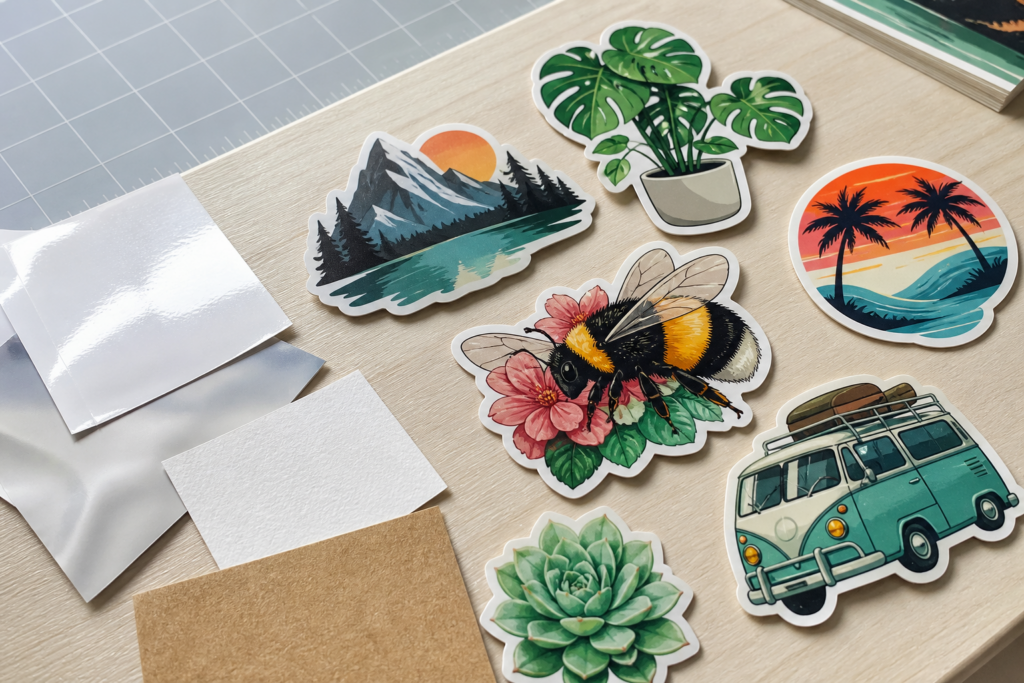
The lowest sticker price isn’t automatically the best value, since a sticker that fades, lifts, or tears early ends up costing more once you factor in reprinting it. A more useful approach is to match the material to the job instead of defaulting to the cheapest option across the board.
| Material | Best for | Main advantage | Limitation |
|---|---|---|---|
| Standard gloss calendered vinyl | Flat surfaces: packaging, laptops, indoor signage | Economical; water- and UV-proof as-is | Less suited to complex curves |
| Cast vinyl + laminate | Vehicles, curved equipment, long-term outdoor use | Conformable; rated up to 8 years outdoor / 10 indoor | Costs more than standard calendered vinyl |
| High-tack cast vinyl | Rough or low-energy surfaces: certain plastics, moldings, powder coating | Extra-strong initial grip | Effectively permanent; not meant to come off cleanly |
| Paper | Short-term indoor use only | Most economical option | Weak moisture and tear resistance |
Calendered vinyl (vinyl pressed into sheets rather than cast) is generally the more budget-friendly option for flat, everyday surfaces, and adding a laminate is usually worth the incremental cost for anything that’ll sit outdoors for years or face regular handling.
For compound curves, like a vehicle panel or a rounded piece of equipment, cast vinyl (a thinner, more flexible film made by a different manufacturing process) is generally the more reliable choice. Film manufacturer Avery Dennison positions cast films as the stronger fit for complex, curved surfaces and vehicle wraps, while calendered films are aimed at flatter, shorter-term graphics (Avery Dennison). And for an unproven design, ordering a small test batch before committing to a bulk run remains the cheapest way to avoid paying to reprint a mistake.
Which Die-Cut Option Should You Choose?
As a quick summary of the sections above: choose individual die-cut singles when each sticker needs to work as a standalone piece, like a giveaway or a single logo on a product. Choose a kiss-cut sticker sheet when several designs need to travel together on one backing.
Add a laminate whenever UV exposure or heavy handling is expected. Choose a removable adhesive for anything temporary, and a high-tack adhesive for rough or low-grip surfaces, since neither of those depends on whether the piece is die-cut. Cast vinyl belongs on curves and vehicles; calendered vinyl is the more economical choice for flat, everyday surfaces.
Frequently Asked Questions
What is a die-cut sticker?
An adhesive graphic cut through both the printed material and its backing paper along a custom contour, so the finished piece takes on the shape of the design rather than a standard square or circle. Most are cut on a digital plotter today rather than a physical die, though the name stuck around from the older process.
Are die-cut stickers waterproof?
Yes, when they’re printed on vinyl, which is the standard material for most die-cut stickers. Vinyl resists water in a way paper doesn’t, and adding a laminate improves resistance to sunlight, scratches, and chemicals on top of that. It’s still worth confirming the specific material and finish before applying a sticker somewhere it’ll face constant moisture, like a shower door or a boat, since not every sticker product is built for that level of exposure.
What’s the difference between die-cut and kiss-cut stickers?
Cutting depth. Die-cut goes all the way through the material and backing, so the piece separates into a loose single. Kiss-cut goes through only the top layer, leaving the backing sheet whole, which is why it’s the standard method for multi-design sticker sheets (Roland DG).
Are die-cut stickers removable?
That depends on the adhesive, not the cut. A standard permanent adhesive isn’t meant to come off cleanly once bonded. A removable adhesive, where available, is rated for a limited window, often around two years, before it’s harder to remove without residue. If removability matters for your application, confirm the adhesive type directly rather than assuming based on the cut style.
How much do custom die-cut stickers cost?
There’s no single answer, since price scales with size, material, lamination, and quantity together rather than any one factor alone. As one real, size-matched reference point, Printastic’s storefront priced 50 gloss, laminated, contour-cut die-cut stickers at 3×3 inches at $110 total, with 2-day production, as of August 2026 (Printastic). Treat that figure like a snapshot rather than a permanent rate, since pricing and production times change and a different size, finish, or quantity shifts the total regardless.
Can I order custom die-cut vinyl stickers with no minimum quantity?
Some print shops do offer single-sticker or very small orders, mainly to let a buyer test a design before ordering more. Printastic’s online configurator caps out at a 50-to-500-piece range rather than listing single-unit pricing, so customers needing fewer than 50 can contact Printastic to ask whether a custom quantity is available, rather than assuming it’s part of the standard order form. If testing a design cheaply matters more than a specific vendor, it’s worth asking directly about small-batch options before assuming a storefront’s listed quantities are the only ones available.
Where can I find die-cut stickers near me in Irvine, CA?
Printastic’s production facility sits at 18952 MacArthur Blvd, Suite 100, in Irvine, with local pickup offered at checkout instead of shipping for customers nearby. It’s a practical option if you’re working against a deadline or ordering something bulky enough that shipping feels like overkill. For anything outside driving distance, standard shipping covers the rest of the country at the same production standard.
What’s the difference between die-cut stickers and die-cut sticker sheets?
Individual singles are cut fully through and separate into standalone pieces, while sticker sheets keep several kiss-cut designs on one shared backing sized to fit multiple pieces per page. Sheets are generally the better pick when you want a collection of designs together, while individual singles work better when each sticker needs to stand alone.
How do I make die-cut stickers, or do I need a die-cut sticker maker?
You don’t need any cutting equipment to order finished stickers from a print shop, since the shop owns and runs that equipment for you. Home crafters sometimes use a small consumer cutting machine paired with printable sticker paper for short, one-off runs, but that’s a separate workflow from commercial production, which relies on print-and-cut systems designed for volume and consistent registration between the print and the cut. Unless you’re planning to produce stickers yourself in small batches, ordering from a shop skips the equipment question entirely.
Are clear die-cut stickers different from regular vinyl die-cut stickers?
The main difference is the substrate, not the cut itself. Clear vinyl is a transparent film rather than an opaque white base, letting the surface underneath show through around the design. Standard printing inks are somewhat translucent, so print shops that offer clear stock generally need to lay down white ink beneath the colored areas to keep the design opaque, a technique ink and printer manufacturers describe as improving color vibrancy and opacity on difficult substrates (Roland DGA).
Whether Printastic’s current lineup includes a clear die-cut option isn’t confirmed on its standard configurator, so confirm directly before designing around it. An opaque white vinyl sticker skips the extra step, since it already has a solid background built in.
What are die-cut car stickers used for?
Die-cut car stickers cover everything from small club or logo decals to larger window and bumper graphics, and the shape-following cut is part of what makes them read clearly at a glance. Because many sticker adhesives are considered permanent once applied, it’s worth checking the adhesive type before placing one on a painted surface you might want to change later, since removal can risk damaging the paint or the sticker itself.
For longer-lived or curved vehicle applications, a cast vinyl construction generally holds up better than standard calendered vinyl, and Printastic’s dedicated vehicle decals line is built specifically for that use case.
Looking for something besides stickers?
Printastic prints banners, decals, signs, and more, all from the same account.
- Browse every product Printastic offers
- Compare formats and materials side by side
Disclaimer
This information is provided for general guidance when selecting, designing, ordering, and applying die-cut stickers. Sticker performance can vary based on material, adhesive, laminate, surface type, environmental exposure, installation, and intended use. Product specifications, available materials, pricing, production times, and durability ratings may also change over time. Before ordering, verify the current specifications for the product you are considering, particularly if the stickers will be used outdoors, on vehicles, on difficult surfaces, or where removability is important. For application-specific questions, contact Printastic before placing your order.
Author & Content Transparency
This guide was created by the Printastic team based on our experience producing custom stickers, decals, signs, and other printed products for businesses, organizations, and individual customers.
The recommendations in this article reflect practical considerations involved in real-world sticker production and use, including material selection, adhesive type, artwork preparation, cutlines and bleed, print quality, durability, surface compatibility, application, and production requirements.
To create this guide, we combined firsthand printing and production knowledge with research from publicly available sources, manufacturer documentation, industry resources, and Printastic’s current product specifications where applicable. Product-specific statements were reviewed against available Printastic information, while broader material and production guidance was supported by relevant industry sources.
We may use AI-assisted tools to help organize research, improve readability, or streamline content development. AI is used as a drafting and editorial aid only. Final content is reviewed, fact-checked, edited, and approved by humans familiar with commercial printing and sticker production before publication.
Our goal is to help customers understand the differences between sticker materials, cut styles, adhesives, finishes, and ordering options so they can make a more informed purchasing decision.
Because product specifications, materials, pricing, production methods, and availability can change, we periodically review and update our content to maintain accuracy and relevance.