
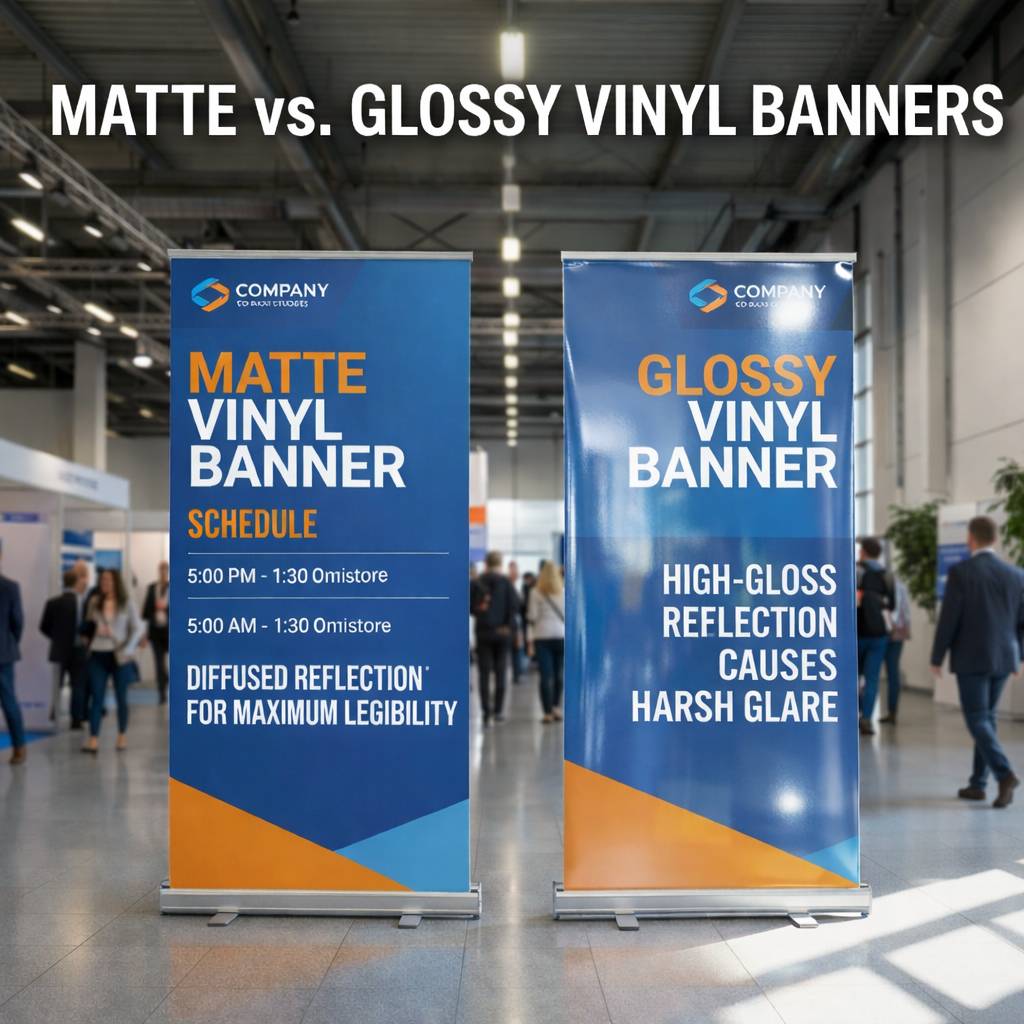
If you’re ordering a vinyl banner and wondering whether to choose matte or glossy material, the short answer is: go matte. Glossy banners are harder to source, more expensive, and — here’s the part most people don’t realize — all banner ink is matte anyway. Printing matte ink over a glossy substrate works against itself. This guide explains why.
How Finish Affects Your Banner
A vinyl banner’s surface finish determines how it interacts with light. A glossy surface reflects light directly back at the viewer, creating glare that washes out your design — especially indoors under fluorescent lighting or outdoors in bright sun. A matte finish diffuses that light, keeping your message readable from more angles and in more conditions.
This isn’t a minor visual preference. It’s the difference between a banner that works and one that doesn’t.
The Ink Problem Nobody Talks About
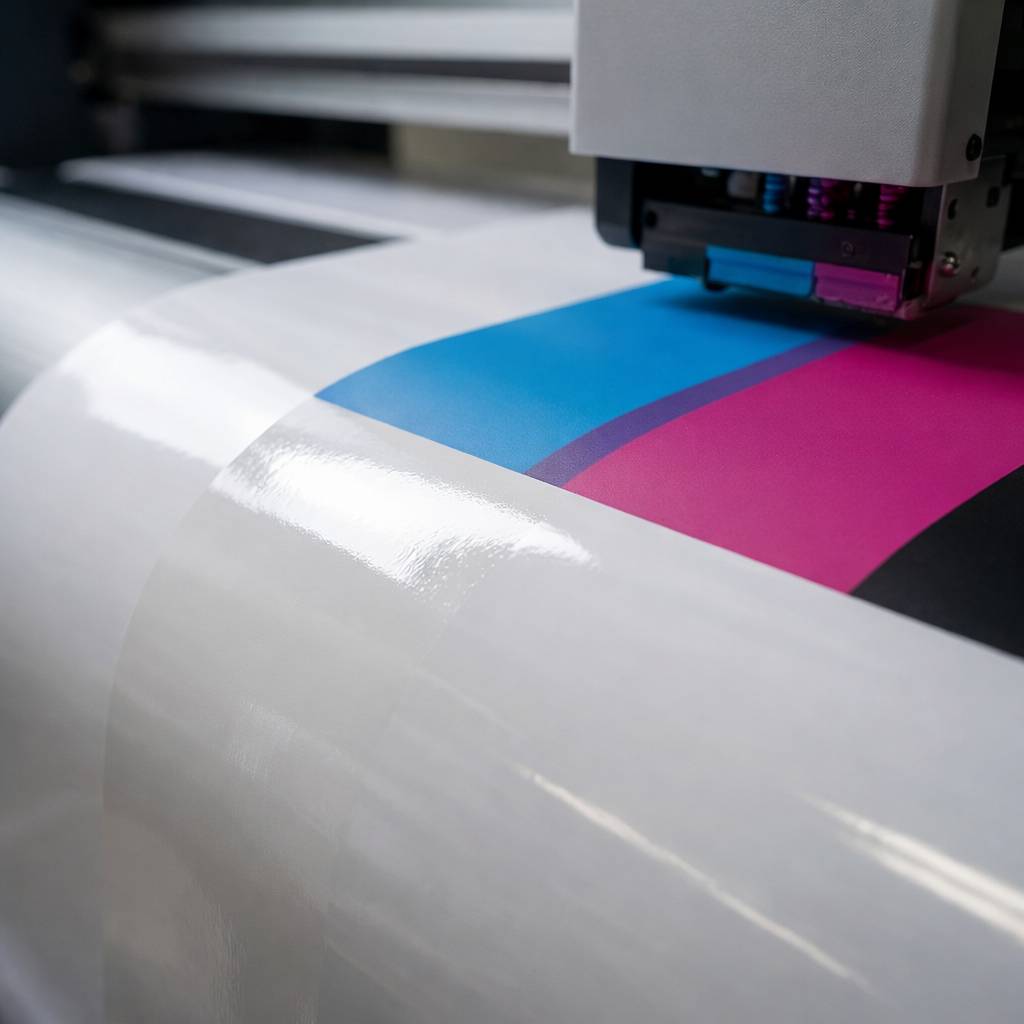
Here’s what most banner buyers don’t know: all wide-format banner ink is matte by nature. Solvent, latex, and UV inks used in commercial banner printing cure to a flat, non-reflective finish. They don’t become glossy on their own.
When you print matte ink onto a glossy vinyl substrate, you get a mismatched surface — the unprinted areas stay shiny while the printed areas go flat. The result is a blotchy, uneven appearance that undermines the clean look you’re going for. The glossy base material only shows through where there’s no ink, which often means the borders, margins, and background areas of your design. Matte vinyl avoids this entirely — the ink and the material share the same finish, so the final product looks consistent.
Why Glossy Banners Are Hard to Find (and Overpriced When You Do)
Glossy vinyl banner material is a specialty item. Most professional print shops don’t stock it because demand is low — and now you understand why. When a vendor does offer it, you typically pay a premium for a product that performs worse in real-world conditions. Some printers push glossy as an “upgrade,” but that’s a sales tactic, not a technical recommendation.
When Does Glossy Make Sense?
In very specific contexts — backlit signage, retail shelf displays, or photo-quality prints under controlled lighting — a glossy finish can add depth and vibrancy. But vinyl banners aren’t installed in controlled environments. They go up in parking lots, trade show floors, gyms, storefronts, and event spaces where uncontrolled light and multiple viewing angles make glare a consistent problem. For banner applications, the practical case for glossy is thin.
Matte vs. Glossy at a Glance
| Factor | Matte Vinyl | Glossy Vinyl |
|---|---|---|
| Glare | Minimal | High |
| Readability in direct light | Excellent | Poor |
| Ink consistency | Matched finish | Mismatched |
| Availability | Widely stocked | Specialty/limited |
| Price | Standard | Premium |
| Best use case | Banners (all types) | Controlled indoor displays |
Does It Matter Whether the Banner Is Indoors or Outdoors?
Not really — matte outperforms glossy in both environments. Indoors, overhead lighting and window light create hotspots on glossy surfaces; anyone standing at an angle to the banner may see reflected light instead of your design. Outdoors, direct sunlight is even more aggressive, and a glossy banner can become effectively unreadable for large portions of the day depending on sun position and viewing angle. Matte handles both cleanly.
What About Durability and Weather Resistance?
Both finishes use the same base vinyl material and offer comparable UV resistance and weather resistance when using quality 13oz or 18oz vinyl — the finish is a surface characteristic, not a structural one. If anything, glossy surfaces show scuffs, fingerprints, and surface wear more visibly than matte, which tends to hide minor handling marks.
Printastic Recommendation (and Why)
At Printastic, all vinyl banners are printed on matte material to reflect these real-world performance considerations. — and that’s a deliberate call, not a supply issue. Matte is simply the better product for banner applications, which is why our full banner lineup is printed on 13oz matte vinyl.
You can browse and order matte vinyl banners directly at printastic.com/vinyl-banners.
For a more technical breakdown of matte vs. glossy vinyl finishes, surface characteristics, and print science, continue below.
The Complete Guide to Matte vs. Glossy Vinyl: Finish, Print Science, and How to Choose
Understanding the difference between matte and glossy vinyl means looking at how each surface interacts with light, how ink bonds to each substrate, and what real-world conditions determine which finish performs better. This section covers the full technical picture for buyers, designers, and print professionals.
Printing Standards, Ink Types, and Material Behavior (Technical Context)
Professional print production follows established guidelines for color accuracy, material compatibility, and durability. Organizations like PRINTING United Alliance publish best practices for wide-format printing, including how different substrates and finishes affect output quality.
Ink Types and How They Affect Vinyl Finishes
The type of ink used in large-format printing directly impacts how matte and glossy vinyl perform:
- UV inks cure instantly under ultraviolet light and sit on top of the material surface. This often produces sharper detail and higher contrast, especially on glossy vinyl.
- Latex inks are water-based and flexible, allowing them to bond well with a wide range of vinyl materials. They are commonly used for matte finishes where reduced glare and durability are important, especially in systems designed around UV vs latex printing technology differences in adhesion and flexibility.
- Solvent inks penetrate deeper into the vinyl, creating strong adhesion and long-term durability. This makes them a common choice for outdoor signage, where material performance depends on environmental exposure and ink–substrate interaction in print materials, as documented in research and validation work by Fogra.
Why This Matters in Real-World Printing
These differences in ink behavior and material interaction affect:
- how colors appear under different lighting conditions
- how well a print holds up outdoors
- how consistent the final result looks across large surfaces
This is why professional print shops don’t choose matte or glossy based on appearance alone. The decision depends on how the ink system, material, and use case work together.
Matte vs. Glossy Vinyl: What the Surface Finish Actually Does
A vinyl banner’s finish describes the microscopic texture of its surface. Matte vinyl has a microscopically rough surface that scatters incoming light in multiple directions — this is called diffuse reflection. Glossy vinyl has a smooth, flat surface that reflects light at a predictable angle — specular reflection — similar to a mirror.
The practical implication is significant. With diffuse reflection, viewers at different angles all receive a consistent, even image. With specular reflection, viewers at certain angles see a glare point — a bright hotspot that obscures the design — while viewers at other angles may see the image normally. In a public-facing banner installation, you can’t control the viewing angle. Matte removes that variable.
How Matte Vinyl Handles Direct Light and Reflective Surfaces
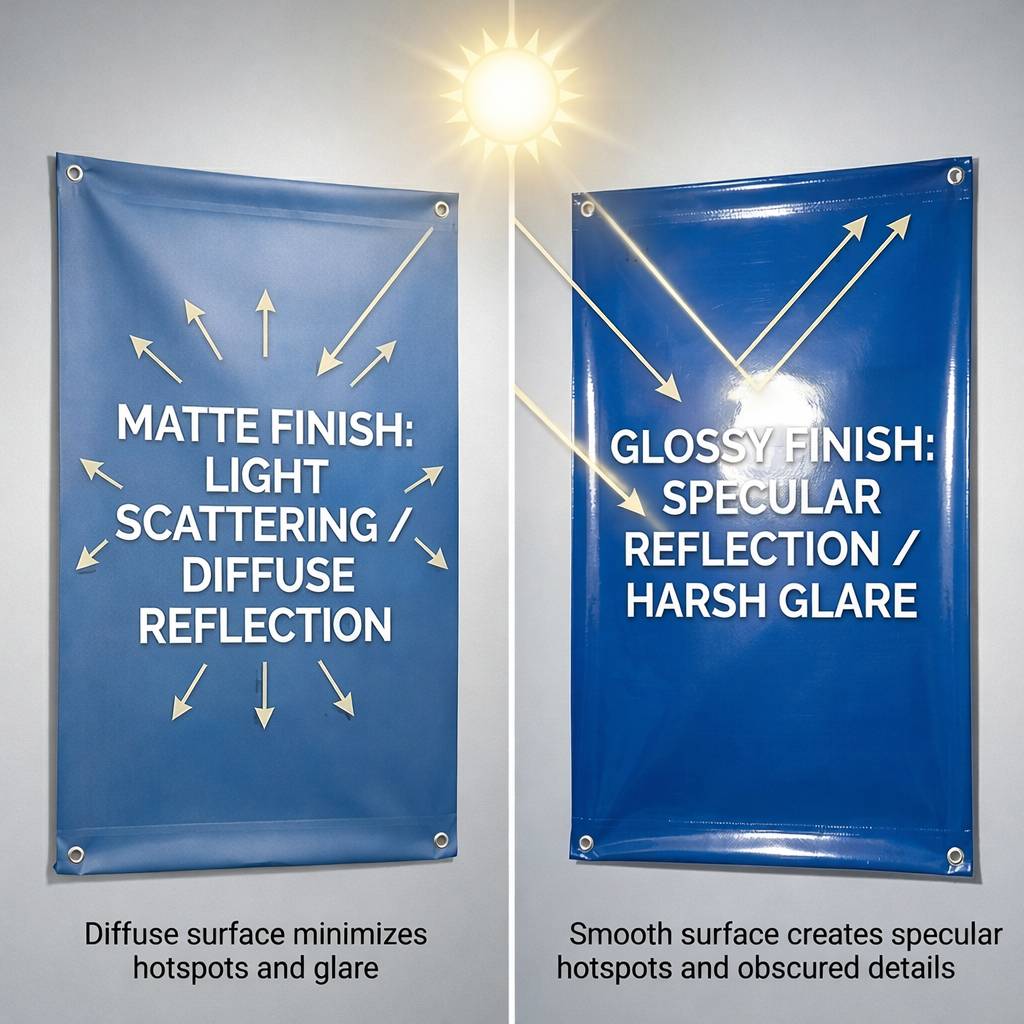
Matte finish doesn’t eliminate all reflected light — it disperses it. This is why matte banners appear readable when light is shined directly at them, and why they work well mounted against both reflective surfaces (like windows or white walls) and non-reflective surfaces. The absence of specular reflection means there’s no single angle where the banner becomes unreadable.
Glossy vinyl, by contrast, behaves much like a glossy surface in photography: when light hits at the right angle, the entire image can disappear behind a bright reflection. This is manageable in controlled studio conditions. It is not manageable on a banner hanging over a trade show booth or outside a retail store.
The Print Science Behind Matte Ink on Glossy Vinyl
Wide-format printing — solvent, latex, eco-solvent, and UV-curable — all produce matte ink films when cured. The pigment particles in these inks create an inherently non-reflective surface once dried. This is not a limitation of the ink; it’s the nature of how inkjet pigment ink bonds to a substrate.
When matte ink is applied to glossy vinyl, the result is a two-finish surface: printed areas are matte (from the ink), and unprinted areas retain the glossy substrate. On a banner with full-bleed printing, this effect is minimized — but on designs with white space, negative space, or light-colored backgrounds, the contrast between the matte ink and the glossy base is clearly visible. The banner looks uneven, which no amount of design quality can fix.
Printing the same design on matte vinyl produces a consistent, single-finish result throughout.
Matte Vinyl vs. Glossy Vinyl for Outdoor Use
Outdoor banner installations face a specific challenge: the sun changes position throughout the day, meaning the angle of direct light hitting the banner changes constantly. A glossy banner that reads well at 9am may be completely obscured by glare at noon and readable again by 4pm — not a reliable performance profile.
UV resistance is similar between finishes at equivalent material weights (13oz, 18oz). Both matte and glossy vinyl use UV-stabilized coatings that resist color fading from UV rays. The finish itself doesn’t determine UV durability; the material grade does.
For long-term outdoor use, matte vinyl also has a practical advantage: it doesn’t show surface degradation as visibly. A glossy surface that becomes scratched or dulled over time looks obviously damaged. Matte surfaces wear more gracefully.
Matte Print vs. Glossy Print: What Changes in the Printed Image
A common concern is that matte vinyl will make colors look duller or less vibrant than glossy. This concern is mostly a holdover from consumer photo printing, where glossy paper does produce richer blacks and more saturated color due to how it reflects light.
For vinyl banners, the dynamic is different. Banner artwork is typically designed for high contrast and bold color — it’s meant to be read at distance. The color saturation difference between matte and glossy vinyl at banner scale is negligible compared to the readability loss from glare. A vibrant design on matte vinyl looks better than the same design on glossy vinyl when viewed in real-world lighting, because you can actually see it.
For close-range, photographic-quality displays — product showcases, portrait photography backdrops, fine art prints — the calculus may be different. But those aren’t banner applications.
Matte Vinyl Stickers vs. Glossy Vinyl Stickers: A Different Context
It’s worth distinguishing vinyl banners from vinyl stickers and decals, because the matte vs. glossy comparison works differently in that context.
For stickers and labels, glossy finishes are commonly used for product labels that need to look premium and are viewed up close under controlled retail lighting. Glossy stickers can enhance color vibrancy at close range and offer a polished look for product packaging. Matte stickers offer a more understated, sophisticated appearance and are easier to write on with regular pens.
For banners viewed at distance and in variable lighting, the glare problem dominates the comparison. The sticker finish choice is more genuinely a personal style and application decision; the banner finish choice has a clearer answer.
Matte Vinyl for Vehicle Wraps: A Brief Note
For vehicle wrap applications, matte vinyl eliminates glare from the curved panels of a car body and offers a distinctive, flat aesthetic that’s a deliberate design choice. Glossy wraps produce the opposite effect — a high-shine, polished look that emphasizes the vehicle’s curves. Unlike banner applications, wrap finish selection is primarily aesthetic; both finishes are purpose-designed for vehicle surfaces with appropriate adhesive and flexibility. For signage and banners, there’s no equivalent aesthetic case for glossy.
Why Premium Vinyl Banners Use Matte Material
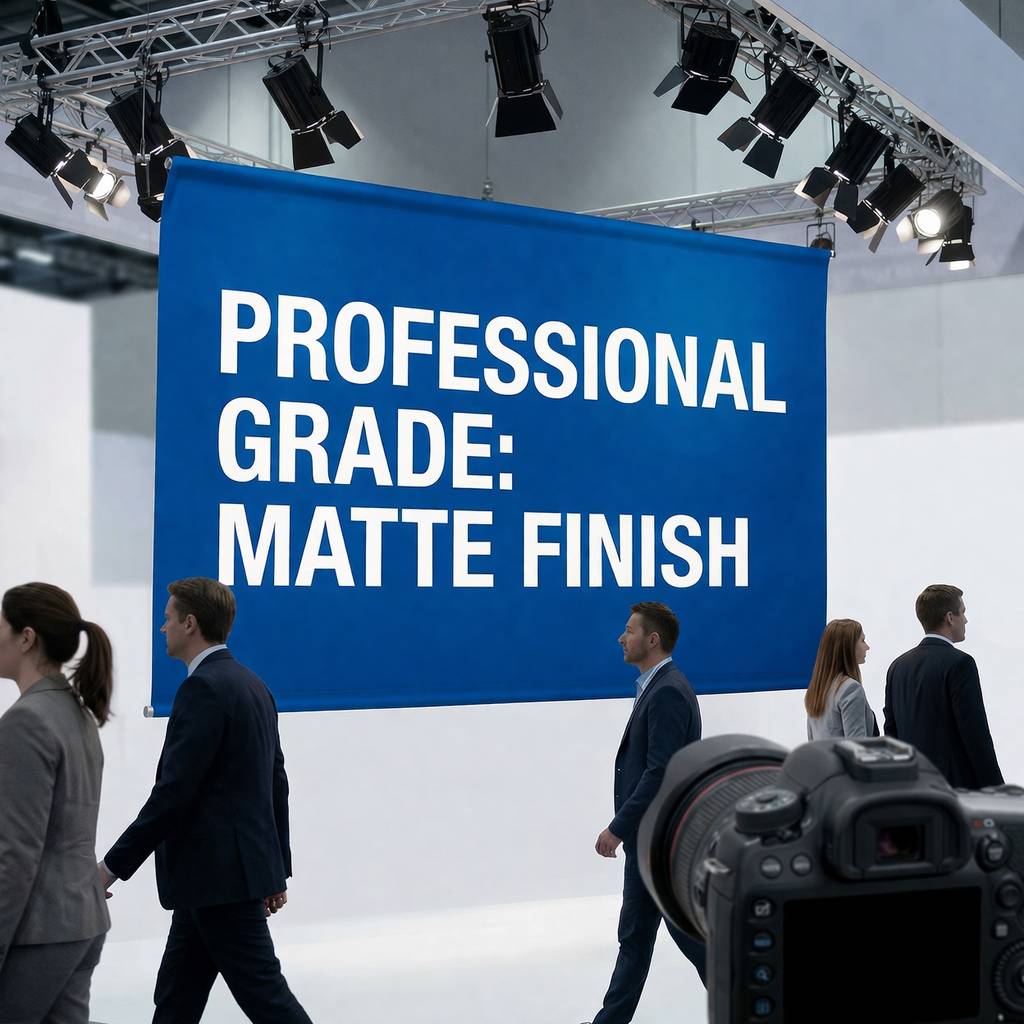
Matte vinyl became the professional standard through practical experience, not convention. Commercial banner applications — trade shows, retail environments, outdoor events, sports venues, building signage — are all high-light, variable-angle environments where glare is a persistent problem. Matte vinyl eliminates that problem consistently. Weather resistance, UV resistance, and durability are comparable across finishes at equivalent material weights. The finish decision, for banners, comes down to one question: do you want glare? The answer is no.
Frequently Asked Questions
What’s the actual difference between matte and glossy vinyl banners?
Matte vinyl has a diffuse, non-reflective surface that disperses light in multiple directions, making it readable from any angle. Glossy vinyl has a smooth, mirror-like surface that reflects light at a specific angle, creating glare that can obscure your design. For banner applications — where viewers approach from multiple angles and lighting is uncontrolled — matte consistently outperforms glossy.
Will my colors look less vibrant on a matte banner?
Not in practice. Banner designs are built for visibility at distance, not for photo-quality close-range inspection. The slight color saturation advantage glossy surfaces offer in consumer photo printing doesn’t translate to banner applications, where the more relevant factor is readability under variable light. Glare on a glossy banner does far more damage to perceived vibrancy than a matte surface does.
Why don’t most banner printers stock glossy vinyl?
Because demand is low and performance doesn’t justify the specialty sourcing. Professional print shops have moved to matte as the standard because it produces better results for banner applications. When glossy is offered, it’s often at a premium price — for a product that performs worse in the real-world conditions banners are actually used in.
Is matte vinyl or glossy vinyl better for outdoor banners with UV resistance?
For outdoor banners requiring UV resistance and durability, matte vinyl is the better choice. Both matte and glossy vinyl offer UV resistance at equivalent material weights, but matte vinyl eliminates glare from direct sunlight, making your banner more readable throughout the day. Matte vinyl banners maintain consistent visibility even when light is shined directly at the surface, while glossy vinyl creates a reflective surface that can wash out your design during peak sun hours.
What is matte vinyl and how is it different from glossy vinyl?
Matte vinyl is a non-reflective banner material with a diffuse surface finish that scatters light rather than reflecting it directly. Unlike glossy vinyl, which has a smooth, shiny finish that creates a reflective surface, matte vinyl offers a flat, non-glare appearance. Matte vinyl is the industry-standard material for vinyl banners because all banner inks are matte by nature — printing matte ink on a glossy surface creates an inconsistent, two-finish appearance that matte vinyl avoids entirely.
How does matte vs glossy vinyl affect indoor banner readability?
For indoor banner use, matte vinyl significantly outperforms glossy vinyl because indoor fluorescent and LED lighting creates intense hotspots on glossy surfaces. When direct light hits a glossy surface at the right angle, the reflected glare can make the entire banner unreadable. Matte vinyl’s non-reflective surface eliminates hotspots and high glare, ensuring your banner remains legible under all indoor lighting conditions — overhead lighting, window light, and direct light from spotlights.
Are matte vinyl banners more durable than glossy vinyl banners?
Matte vinyl banners and glossy vinyl banners offer similar durability and weather resistance at equivalent material weights. However, matte vinyl tends to show surface wear, scuffs, and fingerprints less visibly than glossy vinyl, which makes minor handling marks and scratches more apparent due to its smooth, shiny finish. For long-term outdoor use, matte vinyl’s surface ages more gracefully, maintaining its appearance longer than glossy vinyl, which can look obviously degraded when its smooth finish becomes dull or scratched.
What’s the difference between matte and glossy sticker finishes vs. banner finishes?
Matte and glossy sticker finishes serve different purposes than banner finishes. For custom stickers and product labels, glossy stickers offer vibrant, polished-look color at close viewing range and are a top choice for premium product labels. Matte stickers offer a sophisticated appearance and can be written on with regular pens, making them popular for personal use. For vinyl banners, the comparison favors matte vinyl more decisively — banner viewing conditions involve variable lighting, distance, and multiple angles where a glossy surface creates problematic high glare that matte vinyl eliminates entirely.
Can you get a glossy finish on a matte vinyl banner using laminate?
Yes — a gloss laminate can be applied over a matte vinyl banner to add a protective glossy surface. However, this approach reintroduces the glare problem that matte vinyl eliminates, and adds cost and production time. For most banner applications, laminate is unnecessary; matte vinyl is weather resistant and durable on its own. Lamination is more commonly used for close-range signage like retail displays and product labels where a polished look and surface protection are priorities, not for standard vinyl banners.
How does matte vinyl compare to glossy vinyl for car wraps and vehicle graphics?
For matte wrap and vehicle graphics applications, both matte and glossy vinyl finishes are used intentionally for different aesthetic effects. Matte vinyl wraps produce a flat, non-reflective surface that creates a distinctive, sophisticated appearance. Glossy vinyl wraps produce a high-shine, polished look that emphasizes the vehicle’s curves. Unlike banner applications — where matte is the clear functional choice — vehicle wrap finish selection is primarily an aesthetic and personal style decision, as both finishes are purpose-designed for vehicle surfaces with appropriate adhesive and flexibility properties.
Is matte print vs glossy print a meaningful choice for custom vinyl banners?
For matte print vs glossy print decisions on vinyl banners, the choice is straightforward: matte print on matte vinyl is correct, and glossy vinyl with matte ink creates an inconsistent finish. All commercial banner printing — whether solvent, latex, or UV — produces a matte ink film when cured. This means printing on glossy vinyl results in printed areas that are matte (from the ink) and unprinted areas that are glossy (from the substrate), creating a visually uneven surface. Matte vinyl produces consistent matte finish throughout the entire printed banner, which is why matte is the best bet for professional-quality banner printing.
Ready to get started? Order your custom matte vinyl banners here.
Disclaimer
This guide is provided for general informational purposes only and reflects typical performance characteristics of vinyl banner materials based on common industry practices. Actual results may vary depending on factors such as lighting conditions, installation environment, viewing angles, design choices, and printing methods.
Material availability, printing processes, and substrate specifications can differ between print providers. Readers should confirm details with their chosen print vendor before making final decisions, especially for specialized applications or large-scale installations.
This content is intended to help inform material selection but should not be considered a guarantee of performance in every scenario.
Author & Content Transparency
We are committed to publishing practical, accurate, and trustworthy content that reflects real-world experience in vinyl banner printing and material selection. This guide is based on hands-on knowledge of wide-format printing processes, including how matte and glossy substrates perform under actual lighting and installation conditions.
Some sections may be supported by AI-assisted tools to improve clarity or structure, but every piece is carefully reviewed, edited, and validated by team members with direct experience in banner production, print materials, and customer use cases.
We do not rely on automation alone. Our content is grounded in real production insights—how materials behave when printed, installed, and viewed in environments like trade shows, retail spaces, and outdoor settings. The goal is not just to explain differences, but to help you make better decisions based on how banners actually perform in practice.
Whether you’re comparing finishes or planning a banner order, this content is created with a focus on clarity, accuracy, and real-world usefulness—not just theory.